

June 3, 2024

In which I realize I’m going to be visiting three neighborhoods
In which I gawk at the Kingsbridge Armory and eat lunch nearby at an appropriately-logo-ed diner
In which I wander the streets with “Kingsbridge” in their name and admire the stair-streets
In which an inspiring executive conducts an inspiring tour of an inspiring community center
In which I explore Van Cortlandt Village, where I am reunited with the Jerome Reservoir, and where I introduce two of the four early 20th-century Jewish socialist housing complexes
In which I make my way down the hill to Kingsbridge proper, with a stop at a new library
In which I see a famous park, a newish library, and some pretty normal-looking houses
Music for today
*******
Today’s visit to the northwest Bronx brought the greenest views I’ve seen in my wanderings. The foliage has exploded, obscuring vistas and popping pollen, but I’m not complaining. This is glory.
I traveled with a friend to visit the neighborhoods jointly known as Kingsbridge. They are really three distinct neighborhoods: Kingsbridge Heights, Van Cortlandt Village and Kingsbridge. Kingsbridge Heights sits above (literally, up the hill from) and to the east of the Major Deegan Expressway; Van Cortlandt Village lies to north of the Heights, and Kingsbridge proper lies in the flats to the west of the Deegan.
I hadn’t realized before I arrived that I was going to visit three neighborhoods. Three for the price of one! I love a bargain.
The New York Times has reassured me that I can be forgiven for confusing the Kingsbridges and Van Cortlandts, though: there is not even close to a consensus among the locals on what to call their neighborhood.
Kingsbridge is named for the King’s Bridge, the first crossing from Manhattan to the mainland at what is sort of the Bronx. The bridge, built in 1693, was buried when the City filled in the creek it traversed. Legend has it that parts of the bridge are buried near Marble Hill.1
Kingsbridge has a proud history and its very own, very active historical society. They will remind you that between 1775 and 1777, Revolutionary War hero Paul Revere crossed the King’s Bridge at least ten times, a slo-mo comms system that served to warn the colonial army of British positions and plans.
Kingsbridge was initially part of the Town of Yonkers. It included all of the western Bronx including today’s Riverdale and Spuyten Duyvil (and Kingsbridge Heights, depending who’s opining). Eventually it broke off and became an independent town called Kingsbridge. In 1874, the City of New York annexed the western part of the Bronx, including Kingsbridge, and voilà, Kingsbridgers were Big Apple dwellers.2
In the 20th century, Irish families began to move into Kingsbridge. The Irish enclave remained strong until the 1970s. Read on to meet some relics.
On our visit today, we spent most of our time in the upper level, that is, Kingsbridge Heights and Van Cortlandt Village. The diversity we saw – socioeconomically, architecturally and topographically – was striking.
The Armory
Our arrival was complicated by the straphanger’s worst nightmare: a fatality on the tracks at a distant station, in this case on the #4 line. The tragedy shut the system down when we were still more than 80 blocks from our destination. We didn’t have time to take the bus, so we took a cab to our starting point: the Kingsbridge Armory, which sits atop the #4 train’s Kingsbridge Road stop in the area known as Kingsbridge Heights.
The armory is staggering to behold. It’s the largest armory in the country – some say in the world. The fortress-like behemoth takes up most of its five-acre lot, commanding a presence in the neighborhood that you would associate with a military installation in, say, medieval France. Its 180,000-square-foot interior makes it one of the largest indoor spaces in New York City.
Built between 1912 and 1917, it served as an armory for the first half of the 20th century. Since then, it has served no consistent purpose, with stints as a homeless shelter, a meeting place for the U.N. while its current headquarters was under construction, a production site for the Will Smith film I am Legend and the occasional location for music videos.3
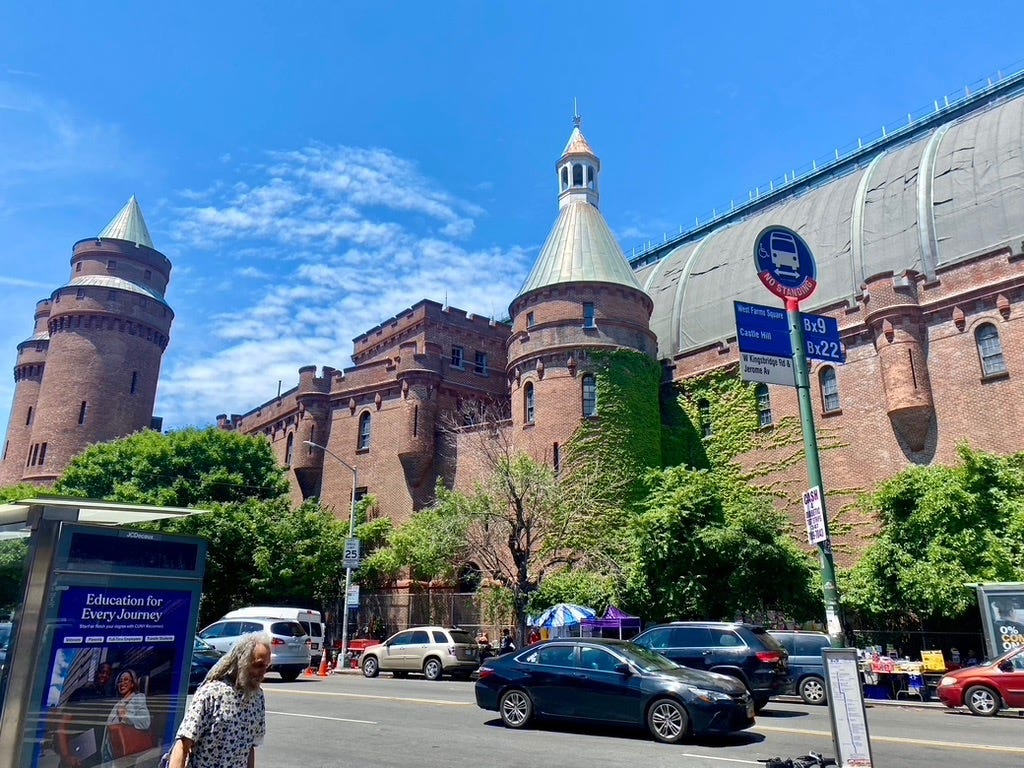
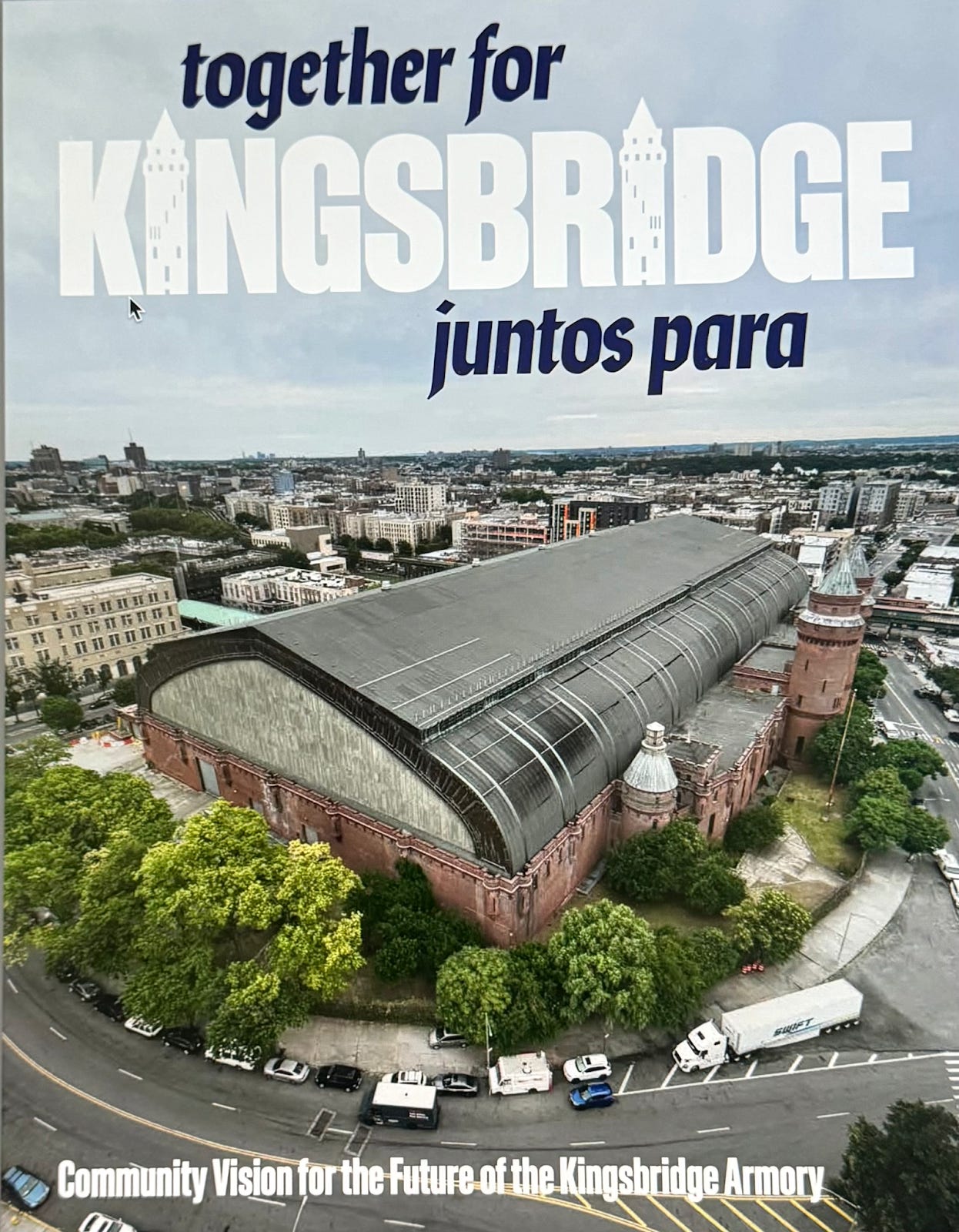
The City acquired the Armory in 1996, about 20 years after it was landmarked and placed on the National Register of Historic Places. Its redevelopment has been a thorn in the side of many a mayor. Two serious proposals have failed: one, for a shopping center, and one for a skating rink. The City recently closed a $1 billion competitive solicitation for new proposals, informed by a nine-month community engagement process which culminated in a planning document called Together for Kingsbridge/Juntos para Kingsbridge. The plan prioritizes diverse industries, from film and TV to manufacturing to urban agriculture and recreation.
According to the New York Times, the likely winner is a nonprofit economic development coalition that would create a multi-use facility intended to benefit the local community.4
How many armories are there in New York City, you may wonder, as I did? It’s hard to say, because most of them are no longer used to store armaments or to garrison troops (though the National Guard does continue to use some of them). This wonderful tracker counts 24, with another 14 that no longer exist. Four are in The Bronx. Many of them have been repurposed. I believe Kingsbridge is the only one that remains completely vacant.
Poor Kingsbridge. Its emptiness is preposterous in a city that hungers for useable space. I’m keeping my eye on what happens here.
Capitol Assets
There are not many dining options around here. We ate lunch at the New Capitol Restaurant, a family-owned diner whose logo (imprinted on its menu) features the mighty turrets of its once-military neighbor across the street. The staff were exceptionally friendly, even bringing us unsolicited cups of soup when they learned we’d declined the fries that came with our orders. Let’s say that other than that unexpected gift (oversalted but generous), we got what we expected.
I noticed the building that housed the restaurant had a For Sale sign. I asked the waitress about it. She said she didn’t know much, that there were rumors of a galleria/shopping center. She told me she didn’t live in the neighborhood - she commutes from Washington Heights in Manhattan - so she’s not very invested. Aren’t you concerned about your job, if the new owner closes the restaurant? I asked. No, she responded – nothing lasts forever. What about the Armory? I inquired. What would you like to see there? Again she demurred, resorting to her not-my- neighborhood explanation, as if it were an explanation. It’s pretty clear she wasn’t among the 4,000 people who stand Together for Kingsbridge/Juntos para Kingsbridge.


The Kingsbridges
After gawking at the Armory for a while, we followed its south-facing façade along West Kingsbridge Road, which is the southern border of Kingsbridge Heights. A makeshift flea market separates the street from the Armory’s wrought iron fence. Clothes, shoes, electronics, serving platters – you name it, someone was selling it. (Unfortunately for the vendors, I didn’t see that anyone was buying it.) The area inside the fence is referred to as the Armory’s “moat,” though water likely never flowed there. But the density of the market’s wares created its own sort of defense.
Kingsbridge Heights’ residents, by the way, are demographically similar to much of the Bronx. About two-thirds are Latino (majority Dominican), 31% are Black and the tiny balance is white, Asian, mixed or unknown. That’s pretty much what I would have guessed from my anecdotal observation.
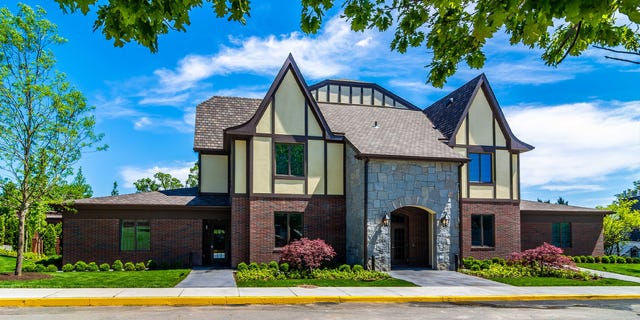
At the corner of Webb Avenue is the James J. Peters VA Medical Center, a 431-bed hospital and nursing home that’s been around for more a century. I was surprised to learn that every borough has at least one VA healthcare facility, though the Kingsbridge facility is, well, the king of them all. In 2019, the VA built accommodations for the families of veterans receiving care here - two Tudor-style houses, 16 rooms each. That’s rare for a New York City hospital, and beautiful.
My friend and I were walking with purpose, because we were expected (and running late) for a tour of the Kingsbridge Heights Community Center (KHCC). From West Kingsbridge Road, we walked up Kingsbridge Terrace (Road, Street, Terrace, Heights – where’s their imagination?).
Kingsbridge Terrace is a really pretty street, lined by houses and apartment buildings of all styles, from the non-descript to the fanciful. One house (#2744) is a veritable castle, a stucco structure with a high crenellated turret. It’s ubiquitous in Kingsbridge neighborhood profiles.5 At a neighboring house, a tower narrows to a dramatic spire.
All the houses on the east (uphill) side of the street are built into the hill, with their entryways atop sometimes long and steep stairways. Some homeowners have decorated their stairs with plants and flowers, their railings draped with colorful ribbons. I tried to imagine toting bags of groceries up those flights, especially on an icy day. Hats off - and cleats on - to the residents who do.


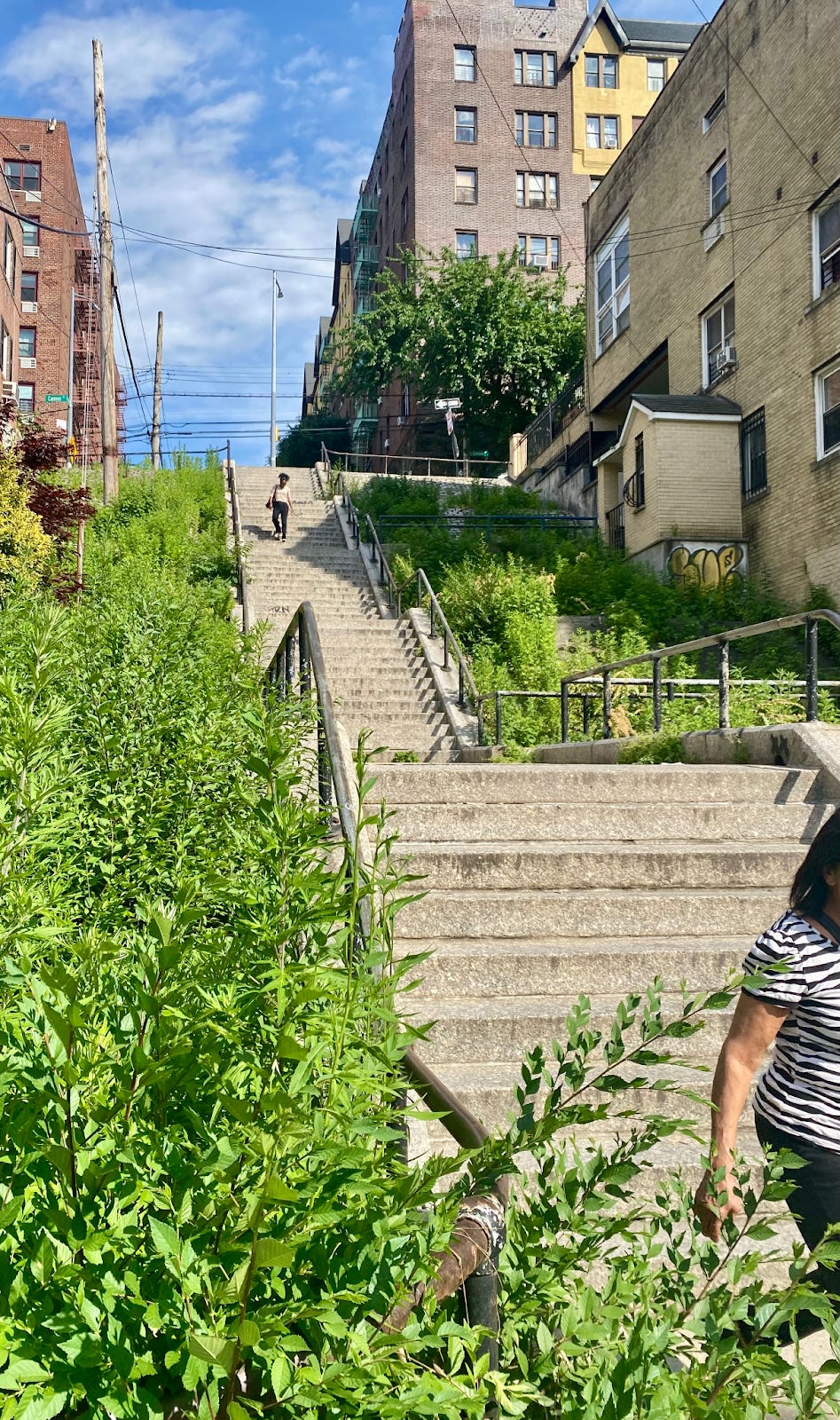
Some of the cross streets are literally stairways – quite steep ones in most cases. The stairs serve as shortcuts between the switchbacking hillside streets. The City confers street names – including numbered street names – to stair-streets.6
One of those stair-streets is just steps (sorry) away from P.S. 360. This stairway, otherwise known as West 231st Street, is bordered on both sides by children’s paintings of trees. On the left the kids have portrayed a bright blue tree in the winter, with a few sparse flowers; on the right, blossoms blanket a bright tree. The paintings follow the six tiers of the stairway, each with a small landing in between, in what is a clever and quite beautiful design. Sadly, the paint has faded and cries out for a re-do.


The artwork is the creation of children from the programs at KHCC, a vibrant organization providing services for families that operates out of three buildings across from the “tree-lined” stairway.
KHCC is a valued community stakeholder, and as such, it was part of the Together With Kingsbridge/Juntos Para Kingsbridge advisory group. My companion had recently joined KHCC’s Board of Directors, and had arranged for us to tour the facility.
It’s no fun if you don’t try other options once you know they exist
KHCC has been providing services to the Kingsbridge community for half a century. Children and youth, from infancy through adolescence, find imaginative, safe and affordable care and activities here, while older neighborhood residents come for food assistance, mental health services or just to work at the extensive vegetable garden.
My friend and I were ushered into a small room to wait for the Administrative Director of the organization. The waiting room had recently been used for a “Girls’ Group” – a gathering of middle school-aged girls where no topic is taboo. The girls had placed signs on the wall. One poster, decorated with balloons, proclaimed “It’s no fun if you don’t try other options once you know they exist.”
Jeez, I loved that. I thought it could be the title of my entire neighborhood exploration project, if not my outlook on life. You go, girls!
The executive joined us a few minutes later and showed us around KHCC’s comprehensive facilities. Her tour was exhaustive and passionate. She knew everything about every program: its goals, funding and contractual requirements, its history and staff, its physical plant challenges. She showed us the multi-tiered garden, the childcare rooms, the library and after-school activity room, the gym, and the food pantry.
We met the director of food programs, at work on his day off to prepare for the next day’s food distribution (the pantry is open twice a week). No surprise – remember, these are my peeps. As I’ve said, they are unsung (and generally undercompensated) heroes.


Van Cortlandt Village
Leaving KHCC and our magnificent guide, we continued on Kingsbridge Terrace until it changed names, becoming Giles Place (which I’ve heard pronounced with a hard “G”). It’s not just the street that changes names here; this is more or less where Van Cortlandt Village begins.
Well, some people call it that. The NYC Historic Districts Council, in connection with the local community board, coined the name in the mid-1970s as a means of preserving the neighborhood’s distinct housing and history.7 Most people who live there consider their home to be Kingsbridge, but don’t write off the proud and persistent VCVers.
Van Cortlandt Village is bordered by the Deegan Expressway on the west, Van Cortlandt Park on the north, the Jerome Reservoir on the east, and West 238th Street on the south. Ish.
Tree-lined Giles Place curves around (another curved street!) toward Sedgwick Avenue and the Jerome Reservoir. Single-family houses line much of the east side of the street while apartment buildings trace the west. The further north you walk, the higher you seem to move along a socioeconomic ladder too, until the area feels solidly middle class compared to blue-collar Kingsbridge Heights (where 30% of the population lives in poverty).
The winding streets tracing Van Cortlandt Village’s hilly terrain are notable for being part of one of the few extant street plans designed by Frederick Law Olmsted (of Central Park and Prospect Park fame). The story goes that after the west Bronx became part of New York City in 1874, the “City” (read: Manhattan) pushed its numbered street grid and urban designs north, usurping local planning efforts for such features as business districts, parks, housing and transit routes.
Bronx officials, unhappy about the imposition of outside decision-making, hired Olmsted to craft a design they felt was truer to local topography. In the middle of construction, however, a new planning administration took over and dismissed Olmsted, aborting his plan except in the few places it has already been completed - including Van Cortlandt Village.
Socialist Jewish Housing in The Bronx: The Shalom Aleichem Houses
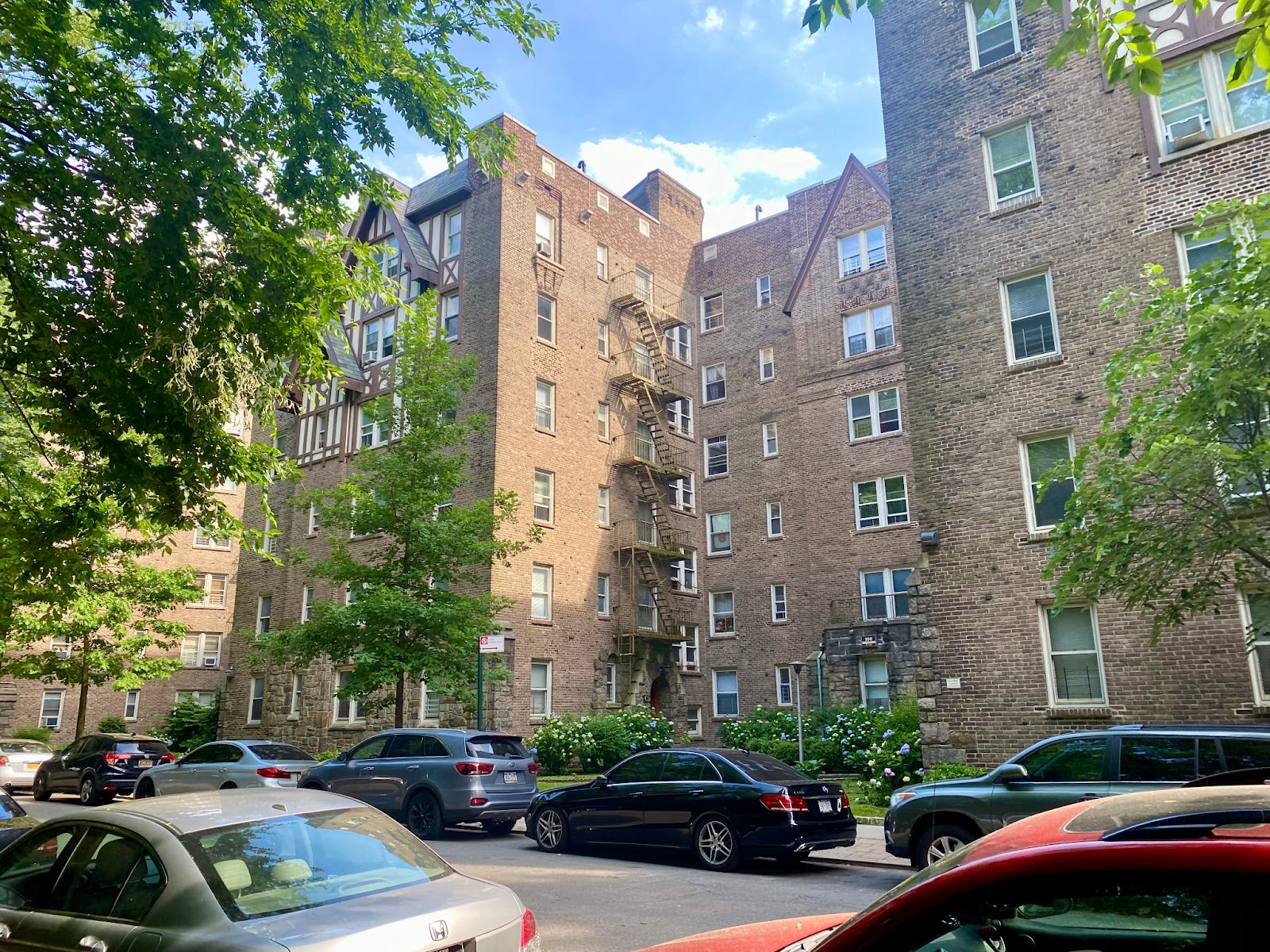
Just before we arrived at the end of the street, we found the entrance to the Shalom Aleichem Houses, one of four cooperative apartment complexes built by and for working-class socialist Jews in the Bronx in the 1920s. In addition to providing affordable, cooperatively-owned housing, each complex had an overtly leftist non-housing orientation: the preservation of Yiddish culture (this one), trade unionism, labor Zionism, or communism. But significant overlap among them meant that prospective buyers had a veritable menu of options to consider, and most could just as easily have lived comfortably in any of the complexes.8
Cooperative housing, a concept less than ten years old at the time these complexes were developed,9 would have appealed to the leftist garment workers who moved here from the squalid tenements of the Lower East Side. The northwest Bronx would have been bucolic at the time, and one can only imagine the awe, courage and resolve these workers would have felt at owning cooperative homes in such a beautiful setting. (Management, it goes without saying, was not welcome.)
The Shalom Aleichem Houses (Yiddish Cooperative Heimgesellschaft) were built in 1926-27 by the Workmen’s (today: Workers’) Circle. Baked into Shalom Aleichem’s purpose and programming was the preservation of secular Yiddish culture. Residents were determined to create a bulwark against the assimilationist tendencies of immigration. The complex attracted intellectual and artistic residents who celebrated Yidddishkeit. Lectures, performances and exhibits took place in extensive common spaces - in Yiddish, of course.10 Shalom Aleichem also included a childcare center, a market, artists’ studios and a cafeteria.
Alone among the four complexes, Shalom Aleichem’s founders built schools - not just weekend enrichment or pre-school programs but actual elementary, middle and high schools. The political environment was famously contentious. To accommodate residents’ political “diversity” (read: friction), two schools operated on-site, one for the Communists and one for the Socialists.
Alas, like two of the other three Jewish workers’ housing complexes, Shalom Aleichem went bankrupt only a few years after it opened; its reserves were no match for the newly unemployed cooperators who had fallen victim to the Depression. The building reverted to a rental property under private ownership. It remains so today, having changed hands several times.
Surprisingly but perhaps not surprisingly, Shalom Aleichem’s failure to thrive as a cooperative entity did not diminish its cultural focus or political activism. In 1932, not long after it became a rental building, tenants - now organized in a (non-owner) cooperative association - staged a rent strike, pledging mutual support no less “cooperative” than if they had been fellow communal owners. It may actually have been a more familiar impulse for them to protest against their capitalist landlords than to muddle through the messy financial machinations and uncomfortable politics required of cooperative ownership.11
One person who grew up at Shalom Aleichem described its residents as “a bunch of Eastern European Jews, every one of them an artist or an intellectual trapped by circumstances in a garment factory.” The daughter of two such residents was Bess Myerson, who in 1945 won the Miss America beauty pageant.12 Myerson went on to serve in New York City government and ran unsuccessfully for Senate in 1980.
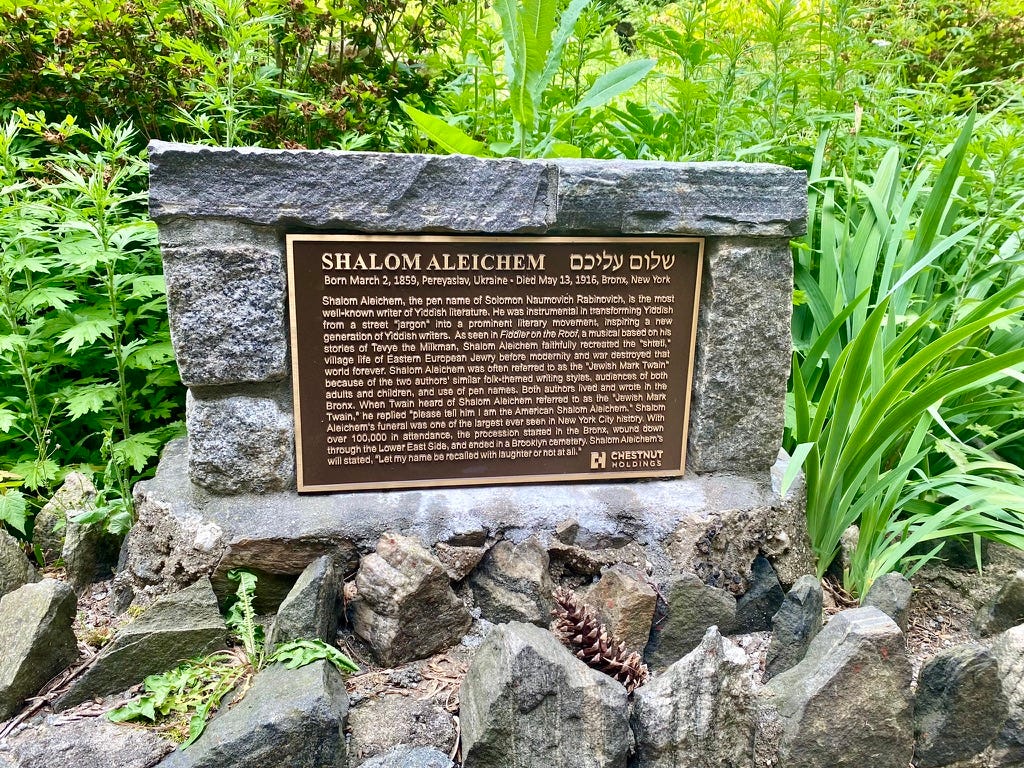
The beautifully landscaped garden in the peaceful interior courtyard we encountered today included a plaque commemorating Sholem Aleichem13 (born Solomon Rabinowitz), the complex’s eponymous writer. Sholem Aleichem’s work has been celebrated throughout the world, most famously for the book Tevye the Milkman, which inspired the musical Fiddler on the Roof. Aleichem died in 1916 in his Bronx apartment.
The Shalom Aleichem Houses’ Yiddishist culture and leftist convictions prevailed until the 1950s and ‘60s, when many left for Riverdale or Westchester County, “replac[ing] the Yiddish socialist dream with the American dream,” as one person put it. Their departure coincided with the arrival of Puerto Rican and Black families to the area. Their “flight” was a painfully ironic one.
Others left because of the fear that their noted radical address made them targets for McCarthyites and the FBI. Still others, of course, left because as they aged, the lack of elevators in the buildings became onerous.
And many did not leave, even if their adult children did.
My friend and I were awed by the 15 five-story brick-and-stucco Tudor style buildings that comprise the complex. It felt like its own small village (and I don’t mean a shtetl). If you closed your eyes, you could hear the arguments (in Yiddish, naturally) between the socialists and the communists, those whose activism involved leaflets and those who painted or played music.
Shalom Aleichem is still a working-class enclave, with some elderly Jewish residents who may even have grown up in the buildings.


Read on for our encounter with another of the projects. The remaining two are further east and destinations for another day’s visit.
Jerome Reservoir and Fort Independence Park
Giles Place dead-ends into Sedgwick Avenue. On the other side of Sedgwick, Fort Independence Park stretches along the northern edge of the Jerome Reservoir. As was true when I visited Bedford Park on the other side of the reservoir, the water itself isn’t visible from the street; the retaining wall is too high for even the tallest person to see over even at the crest of a high jump. (You do get a narrow stripe of a view from the park, though, and recent improvements are intended to enhance the views.)
Fort Independence itself was indeed a fort. Built in 1776 at the direction of General George Washington, it was destroyed by the British three years later. In 1915, cannons were discovered buried underground at the site of today’s park, presumably from Revolutionary War days. That’s when the City memorialized the space as a park bearing the fort’s name.
I smiled as I considered that the name had survived for almost a quarter of a millennium while the fort lived only three years.
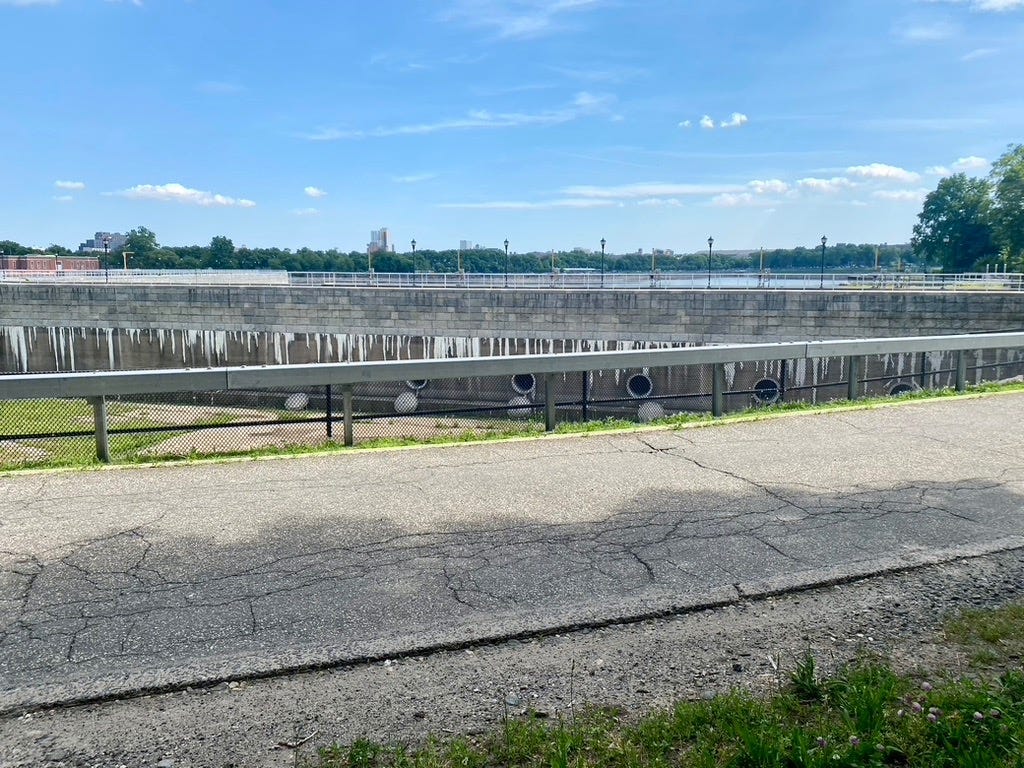
The reservoir opened in 1906 on the site of the former Jerome Park Racetrack. It was part of the City’s water supply system, holding the water that came in from the Croton aqueduct upstate. To this day the reservoir plays a small role in our water system, with about 10% of the city’s drinking water passing through.
The northeast portion of the reservoir was emptied in 2008 because of the City’s failure to comply with a federal mandate requiring more rigorous water filtration. It’s an unusual look: a stone wall separates the water from the grassy knoll of the drained portion. Locals are frustrated and skeptical that the City will ever implement the enhanced filtration system so it can return the water.
We got a first-hand account from a friendly pony-tailed guy named Mark, who has lived in the neighborhood for nearly his whole life – which I’d guess is 60-plus years. His family moved to Kingsbridge Heights from the South Bronx when he was a kid, and he went to DeWitt Clinton High School in the days when white kids like him would have made up about a third of the student population; today, it’s fewer than 2%. (He would also have been among the 100% of students who were male, since the school did not admit girls until 1983.)
Mark was eager to share his experience living in the neighborhood and gave us a few recommendations. In fact, he walked us around the park on Sedgwick. Van Cortlandt Village boasts some beautiful and interesting houses, some of which he - or others along the way - pointed out. One proud homeowner, who waved to Mark, made sure we understood his house was almost 100 years old; Mark showed us another home with brilliant blue stained glass trim above all the windows and doors; still another stood out for its solar panels installed atop a severely pitched roof.


We passed the former Van Cortlandt branch of the New York Public Library, which was a big deal when it opened in 1969 after operating out of a private apartment. In 2019, the library moved around the corner. Next to the (former) library14 is the Van Cortlandt Jewish Center, a modern Orthodox synagogue with space rented to two social services agencies that serve people at either end of the life cycle. (Mark was quick to reassure us that the organizations serve “all kinds of people.”) The VCJC moved here in 1965 and now seeks to sell it.15


We said goodbye to Mark here and walked a block north on Orloff Avenue to Van Cortlandt Park South. (Yes, north to South.) The park – the third largest16 in New York City, at 1,146 acres - was verdant and alluring. I really wanted to hike along its trails, but that would have to wait for another day with more time.
Amalgamated Housing Cooperative
Across from the park is the Amalgamated Housing Cooperative, another of the four socialist Jewish developments from the 1920s. This complex, 11 buildings built along the park’s southern border, was the nation’s first limited-equity co-op, initially built by and for members of the Amalgamated Clothing Workers of America, one of the most important trade unions in the garment industry.17 (“Limited equity” means, among other stipulations, that there are effectively limits placed on re-sale to ensure the permanent affordability of the units.)
Built around a series of courtyards and gardens, the Amalgamated’s physical design, like Shalom Aleichem’s, was inspired by the English garden city housing model, an early 20th century urban planning philosophy that sought to meld city and agrarian life in residential communities. That such an environment could be available - for ownership, no less - to working-class trade unionists and others working in the garment shops was a reflection of remarkable political mobilization and courageous risk-taking.
The Amalgamated Houses are the only one of the four progressive Jewish co-ops that has entirely retained its ownership structure. (Another one, the Farband Houses, has kept two of its four original cooperatives; the other two faced bankruptcy and reverted to rentals not long after they opened.) Originally 300 apartments, Amalgamated expanded in the post-war years to 1,468, the most recent one built and occupied in 1971.
The building’s original financing structure required creative state legislative action and a host of loans (including one from the Yiddish Daily Forward). Above all it involved strategic vision, in this case from socialist-anarchist labor organizer and garment worker Abraham Kazan. Then-governor Franklin Roosevelt praised the model, which has now been replicated for tens of thousands of similarly-structured apartments in New York City and beyond. Kazan himself went on to develop other subsidized housing for middle-income families, continuing into the 1960s with his largest project, Co-op City.
The reasons for the Amalgamated Houses’ success as a co-op, while the other projects fared so poorly, are unclear. They may have had more rigorous governance, assistance from the unions or more creative financial management. Whatever it was, they survived the Depression and marched on. They are still middle-income cooperative apartments.
However, the Amalgamated Houses are experiencing dire financial challenges today. Their infrastructure is outdated, they owe $1.5 million to vendors and tens of thousands to former cooperators. Compliance with State and City inspections is beyond the reach of their diminished reserves (some reports place the cost at $150 million). Amalgamated is seeking a loan from the State’s housing agency and its management is facing angry pushback from residents and former residents. Hopefully a resolution will honor the buildings’ covenants and history. It would be tragic if they too lost their cooperative structure.18
Despite the rumors of their financial challenges, there’s a ten-year waiting list to get in. Just listen to the enthusiasm and devotion of today’s cooperators. It’s infectious.


All Downhill from Here
My friend headed home from here. I continued west.
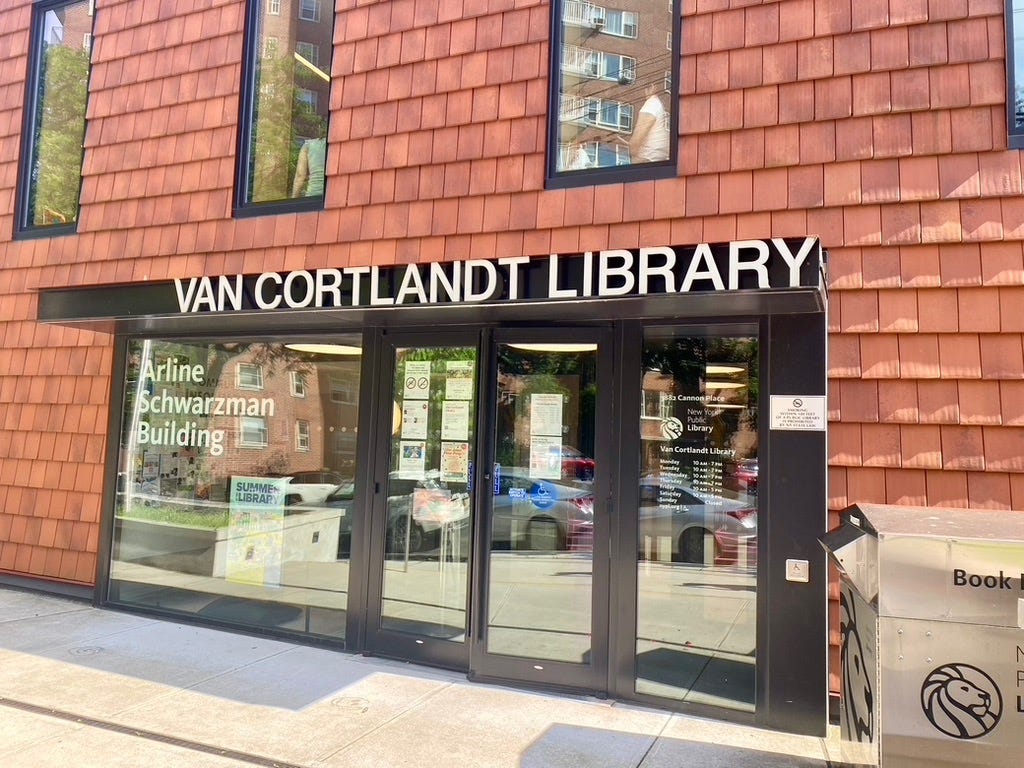
My first stop: the relocated Van Cortlandt branch of the library, on Orloff Avenue. Mark had indicated it was nothing special, but I beg to differ. True, the building is a simple rectangular space. But I loved its red-shingled exterior, with its in-your face sans serif name tag and its light-filled reading room. I understand (and Mark probably does too) why the community appreciates it: it’s more than twice the size of its predecessor, with activity rooms for kids of all ages, Spanish and Russian language books, and an inviting outdoor space with tables and chairs.19
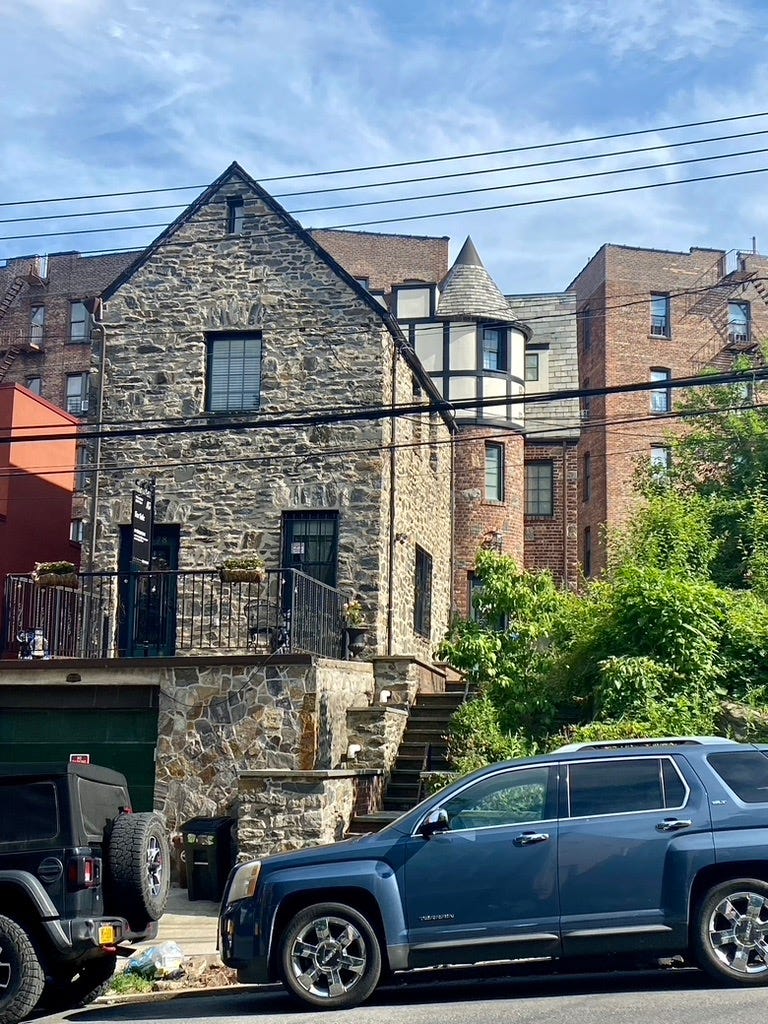
From the library, I followed the twists and turns of Orloff Avenue down the hill toward the Deegan. Detached single-family homes lined both sides of the avenue, most with modest yards and driveways. The home abutting the library happened to be on the market. From the street it was striking, and when I got home I learned it was a 1901 stone-stucco-brick house with four bedrooms, an exposed brick wall with a fireplace, and a huge outdoor patio. The asking price of $999,000 in an area where the median home sale in the past year was $373,500 suggests that gentrification may have arrived in Van Cortlandt Village, a neighborhood that may not remain a hidden gem for much longer.
More of those step-streets dead-end at the bottom of the hill into Bailey Avenue, which hugs the Deegan on the Kingsbridge Heights side. Given that the closest subway to Kingsbridge Heights is in the flats, you might have to hike up those stairs – at least 90 of them – to get home. On a dark, icy night, it wouldn’t be fun. On the other hand, it’s certainly faster than winding your way up the street I had followed down the hill, and you’d definitely get a better workout. (On the other hand, as Tevye might say, you could take the bus.)
Kingsbridge
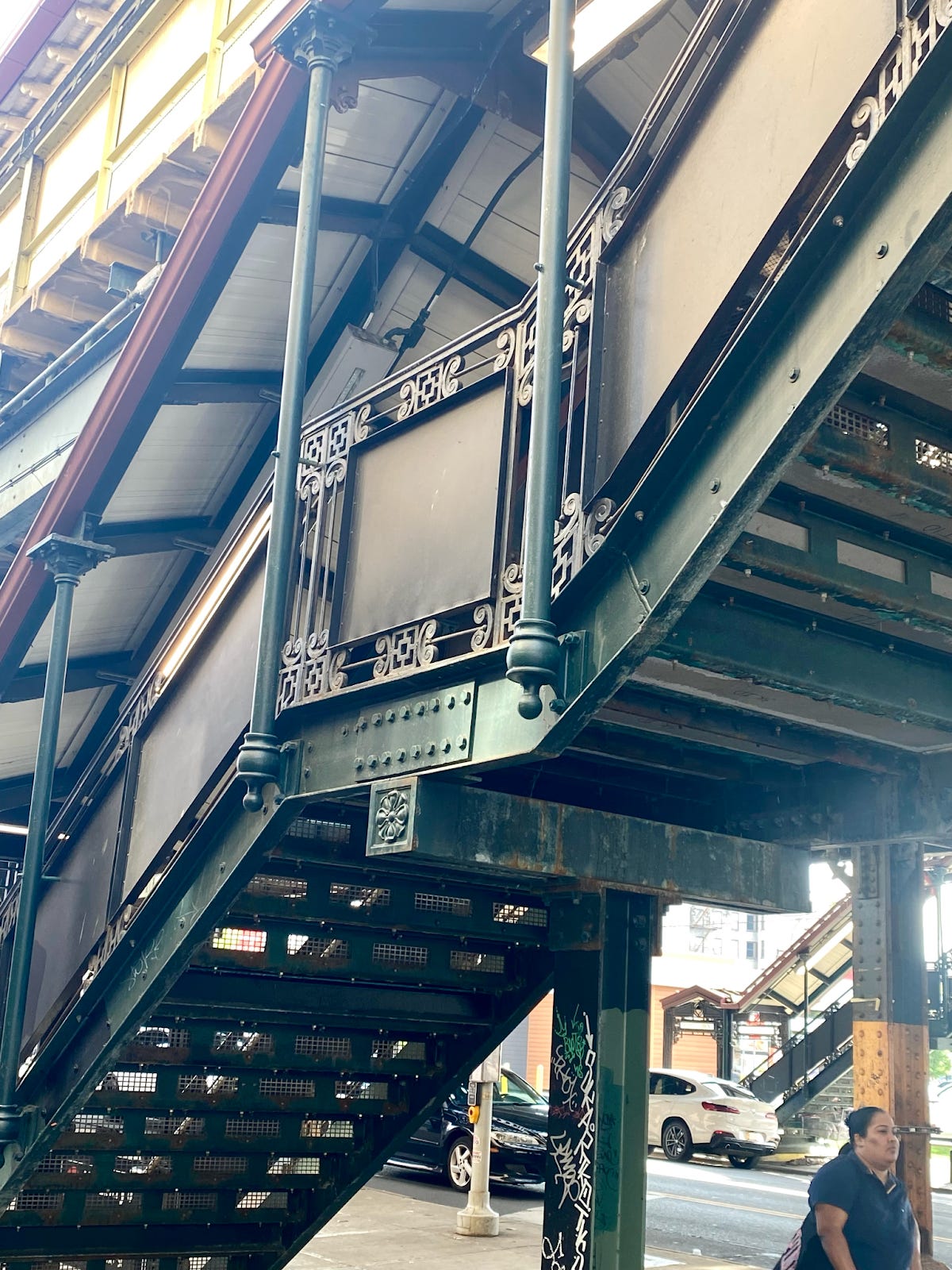
On the other side of the Deegan Expressway is Kingsbridge. Crossing at 238th Street, I immediately noticed the area had a higher concentration of white residents than its uphill neighbors, though it’s still mixed.20 Broadway, the major commercial corridor, is where the elevated #1 train at 238th Street takes you south to Manhattan (43 minutes to Times Square) or north to the next and final stop in Riverdale.
Kingsbridge isn’t a wealthy neighborhood, but its average household income is about 25% higher than the rest of the Bronx overall and than Kingsbridge Heights specifically.
Gaelic Park
A block west of Broadway is the larger-than-I-remembered-it Manhattan College (“100 Years in the Bronx,” its banners proclaim).21 In 1991, Manhattan College, a Lasallian Roman Catholic university, acquired nearby Gaelic Park, a sports stadium on West 240th Street with a storied history. The park was built in 1926 by the Gaelic Athletic Association of New York to provide a social gathering place for the area’s substantial Irish immigrant community - and in particular for Irish sports.
The biggest draw was hurling, a men’s sport involving sticks and balls, which - from descriptions and images I’ve seen - sounds and looks vaguely like lacrosse with sticks that look like oversized mixing spoons. The sticks are called “hurleys” (or maybe “hurlies”?). The women’s version of hurling is called camogie (pronounced ca-MO-ji), which also found a home at Gaelic Park. Both sports remain hugely popular in Ireland, where local teams battle it out in front of large and fanatical crowds. (Here’s a short description of hurling that 60 Minutes made for Americans, and here’s one about camogie, if you’re interested.)
Gaelic Park has also hosted concerts, including, in 1971, one by the Grateful Dead, who played there to 15,000 fans. Deadheads will want to know that the band opened with Bertha.
Manhattan College’s acquisition did not interfere with the athletic programming: the site continues to host Irish as well as American sports. Today, those sports are hurling and Irish football - another Gaelic sport, a strictly amateur one, which is neither like American football nor international “football” (soccer). Tournaments for both continue to fill the stands.22
Alas, however, there’s no more rock and roll at Gaelic Park.
In addition to Gaelic Park’s events, a small organization is keeping hurling and camogie alive in nearby Van Cortlandt Park as well as at CitiField in Queens.


Single-Family Homes
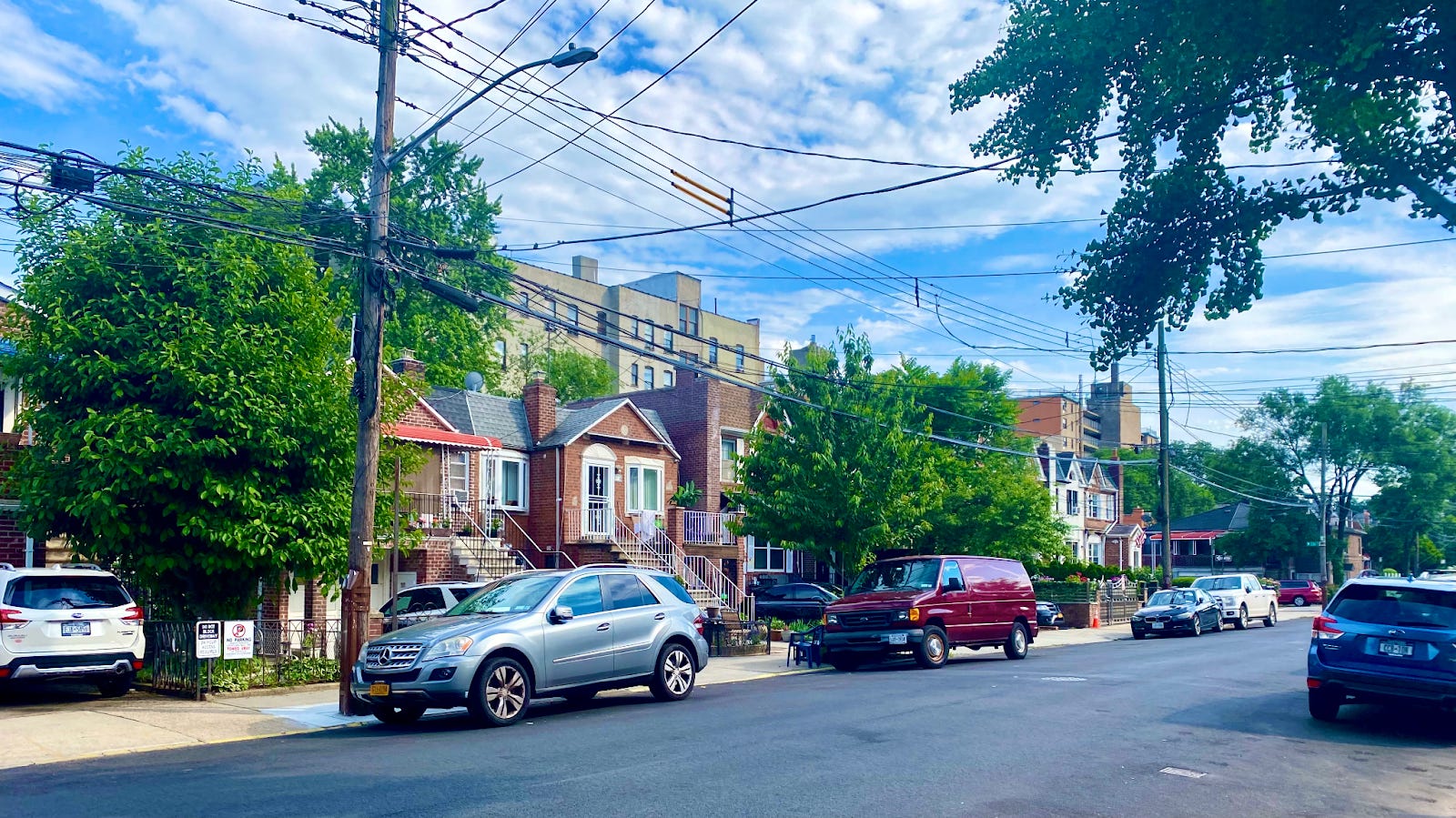
Walking through the streets of Kingsbridge was pretty unremarkable – the kind of unremarkable that appeals to me because it’s a window into how ordinary people live here. But it leaves me without much to report! I saw mostly modest single-family homes notable only to a Manhattanite who covets space – small gardens, sweet little porches, fireplaces.
Free books: Kingsbridge Library and the Pharmacy
I paid a quick visit to the Kingsbridge public library. Kingsbridge has had a library since the early 20th century. The first branch was designed by McKim, Mead & White in 1905, one of 67 funded by Andrew Carnegie in a ten-year period and one of 18 to open that year.23
This lovely essay, by someone who grew up in the neighborhood, recalls the branch in the 1940s when the library was, in her recollection, a “dark one-room site with books waiting to be devoured.” She recalls the hallowed day she got her first library card, becoming, at age five, “a loyal member of the reading community of Kingsbridge.” I expect the thrill persists through the generations here, as it certainly has in my own family.
The current building is the library’s third incarnation, reflecting the growth of the collection and the community. The bare concrete-and-glass Brutalist exterior, with its boxy angles, is a striking (and, to my eyes, elegant) neighborhood attraction. Debuting in 2011, the library’s two floors – even the inviting basement-level children’s room, with its colorful, injury-minimizing soft flooring and foam chairs – are filled with light. Even now, at this late hour (the library is open till 7 p.m. most days), the adult floor was still crowded.
The branch houses the Latino and Puerto Rican Cultural Center, a small room (“El Cuartito”) featuring books, artwork and other resources dedicated to promoting “Latinidad,” or Latino unity.


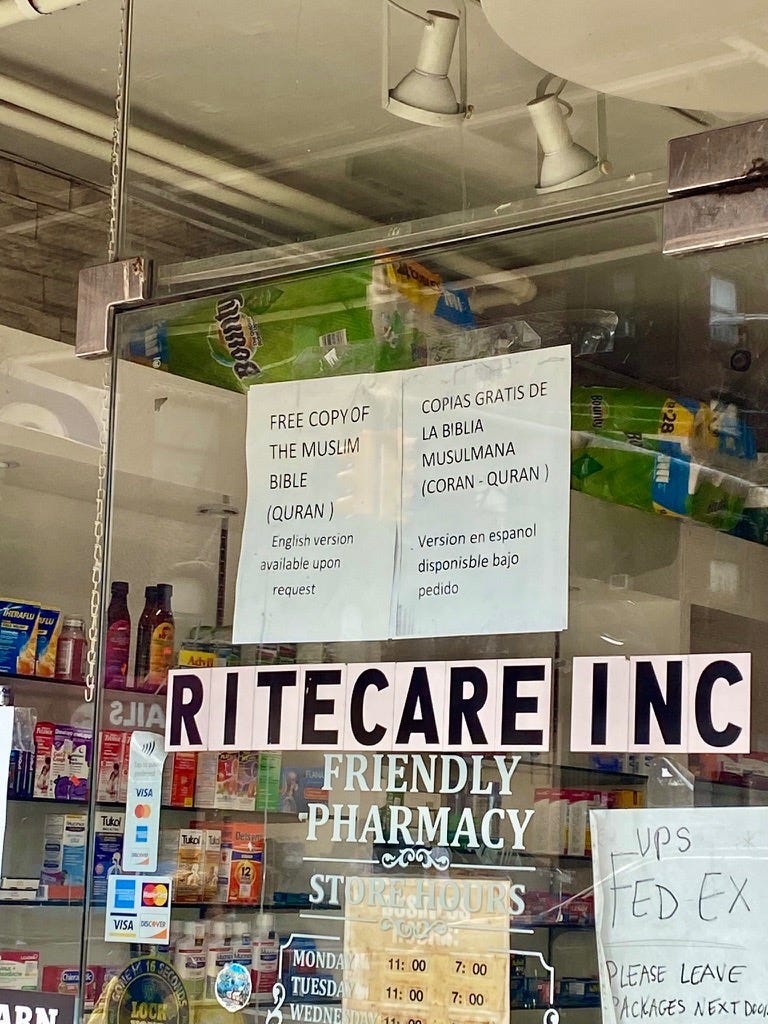
As I headed to the subway at 231st Street, I passed RiteCare Friendly Pharmacy, where matching English and Spanish signs were taped to the glass doors. The signs advertised “Free Copy of the Muslim Bible (Quran) – English [Spanish] version available upon request.” Now that’s a Friendly Pharmacy.
Vexing Voyage
Once again, the subway wasn’t running. No one, including the MTA employee stationed at the 231st Street station, knew why. A kind teenager also traveling downtown (but never below her home on 211th Street, she announced defiantly) accompanied me to a bus stop a block away. Predictably, the bus was jammed, and I lost her once I joined the crowd on board. That was disappointing, because I would like to have understood her hesitation about points south. She doesn’t know what she’s missing. (Or maybe she does, and that’s why she sticks to her boundary.)
The bus crossed into Manhattan, where I got another train home, a few miles and half a city away.
Music for Today
Here’s the entire 1971 Gaelic Park Grateful Dead show.
Wilfrido Vargas, ‘80s Dominican merengue, El Hombre Divertido (ha, ha, ha, or in Spanish, ja, ja, ja).
Motl der Operator, a Yiddish song about a machine operator who is shot while on a picket line. It was written in 1940, for a film of the same name. Residents of the Shalom Aleichem Houses and especially the Amalgamated Co-ops at that time would have known this song. Performed here by Kapelye, an early contributor to the klezmer revival movement of the 1980s.
Notes
The director of the Kingsbridge Historical Society affirms that the bridge is, indeed, buried in Marble Hill. Not to get too far ahead of myself, but a word about that neighborhood: The King’s Bridge crossed the Spuyten Duyvil Creek to connect the Bronx to Marble Hill, then a part of Manhattan Island. Today Marble Hill is the southernmost neighborhood on the Bronx side, that is to say the mainland, but is legally part of Manhattan. When I post about Marble Hill, I’ll describe the quirky history of the waterways north and south of the neighborhood that resulted in this peculiar geography.
Except New York didn’t become known as The Big Apple until the 1920s, when New York Morning Telegraph sportswriter John J. Fitz Gerald introduced it. Fitz Gerald had heard two Black stable hands in New Orleans use the term to refer to New York’s racetracks. He brought it north. In other words, the term is an African American coinage, popularized by an Irishman. In 1997, Mayor Rudolph Giuliani commemorated the corner of Broadway and West 54th Street in Manhattan, where Fitz Gerald had lived. No one knows what happened to the anonymous New Orleans stable hands.
The NYC-based band The Pretty Reckless filmed their song Just Tonight in the creepy-looking abandoned interior of the armory. It may be reckless to concede this in an online forum, but true confession #1: I’d never heard of The Pretty Reckless before researching the armory, and true confession #2: I will likely never listen to them again.
Update: in January 2025, the City announced it had selected 8th Regiment Partners, LLC, a joint venture between Madd Equities LLC and Joy Construction Corp., to redevelop the armory. Their plan calls for an event venue, a recreation center, a workforce development/education initiative, parking and much more (including, possibly, housing, in phase two of development). Stand by, or better yet, have a seat, because the new facility, dubbed “El Centro Kingsbridge,” isn’t scheduled to open its doors until 2032.
The house, built in the early 20th century, was on the market in 2022. At the time, it was divided into three apartments. Here’s some fun information about its history and features.
Michael Cairl’s blog On Foot On Wheels, about visiting NYC-area neighborhoods as a pedestrian and cyclist, includes a link to his inventory of stairway streets. He claims to have climbed (or descended) them all!
The “Van Cortlandt” part, of course, comes from the neighborhood’s green northern border, which in turn takes its name from the Van Cortlandt family, who settled here from the Netherlands in the 17th century. The Van Cortlandts were a land-owning dynasty that owned an 86,000-acre plantation covering much of today’s Westchester County. Van Cortlandt Manor, built by enslaved people in 1748 for a descendant of the original settlers, still stands in Van Cortlandt Park. It’s open to visitors.
Mad respect and abundant gratitude to Micah Wilson, whose 2022 senior honors thesis at Bowdoin College, Building Home in Diaspora: New York’s Jewish Left and the History of the Bronx Housing Cooperatives, I have drawn on for certain details and themes, among other sources.
The first co-op apartment buildings were developed in Sunset Park, Brooklyn, by similarly left-wing Finnish immigrants. The co-ops, called Alku Tonien and the Advance, opened in 1917 and 1921, respectively. Stay tuned for my Sunset Park post.
The 1920 census found about 950,000 Yiddish speakers in New York City out of a total population of 5.6 million! (For context, that’s about double the number of Chinese speakers in today’s New York, though not even half as many as today’s Spanish speakers.) Yiddish-speaking New Yorkers would have been accustomed to reading, viewing and listening in their native tongue, though they may have been despondent - or delighted - to watch their children assimilate. To explore Yiddish culture and commerce in that era, I recommend Henry Sapoznik’s recent The Tourist’s Guide to Lost Yiddish New York City (SUNY Press, 2025).
Wilson, p. 39.
On learning that Myerson was Jewish, three of the five pageant sponsors withdrew their support.
“Sholem” is the Yiddish transliteration, while “Shalom” is the Hebrew. I’ve used Shalom Aleichem for the housing complex consistent with the plaque in its courtyard, but Sholem for the author, the more conventional transliteration of his name. The name, of course, means “peace be upon you” in both languages.
2026 update: I have not returned, but a Reddit posting from a year ago announces that a developer has razed the old library and is building apartments there.
Update: in April 2025, the VCJC announced the sale of the building to a developer for $4 million. Plans include a 5,000-square-foot synagogue as well as other TBD services. The community has expressed concerns about the new development contributing to rising prices in the neighborhood.
You may find it hard to guess what the largest and second-largest parks in the City are. Hint: Central Park is neither.
I was surprised to learn that only 30% of the project’s original residents were union members. That may not have been accidental, as Kazan was eager to spread financial risk across the industries from which paying cooperators drew their paychecks. Wilson, p. 44.
In 2012, a Columbia University-affiliated group compiled an extraordinary reading list of materials related to the Amalgamated Houses. The group, which met from 2009 to 2014, called itself the Amalgamated and Park Reservoir Co-op History and Reading Discussion Group. The materials include several articles by Abraham Kazan, poetry and fiction by residents, technical building specifications and accounts of every chapter of the buildings’ history. They are vivid portraits of what it was like to live there throughout the buildings’ life. And they are available to the public!
You’ll notice the library’s façade refers to the Arline Schwarzman Building. Schwarzman was the mother of Steven A. Schwarzman, billionaire CEO of The Blackstone Group, “generous benefactor” (the library’s term) and trustee of the New York Public Library.
With only a handful of exceptions, Hispanics (mostly Dominicans) represent the majority or plurality of Bronx neighborhoods. Kingsbridge is no exception.
Two months after my visit, Manhattan College announced that it had changed its name to Manhattan University, a rebranding intended to boost enrollment, and its reputation.
Histories of Gaelic Park abound on the internet; it seems to hold a special place in the hearts of many. This New York Times article from 2009 does it justice, I think.
Strictly speaking, the first branch of the Kingsbridge library opened in 1894, above a drugstore. The 1905 branch was the first official, dedicated library space.
I always seem to find connections to your pieces. In this case, I worked out of PS 360 for a couple of years. I commuted up those steps (and sometimes from Kingsbridge) often. I know many of these places but theres so much I wish I had known. Happy to learn it all now. Keep walking! And keep writing.
Wow Rachel. Didn’t know that links to Grateful Dead concerts would be part of the package here.