

November 27 and 30, 2023

November 27
In which I introduce the neighborhood and the neighborhood introduces itself
In which I slurp goat soup and am transfixed by a Nepali song competition
In which I play Guess the Nationality of a grocery store and count the varieties of feta
In which I admire Sunnyside’s residential buildings, where the sunny side of the street light ups up before my eyes
In which I consider Sunnyside Yard, a potential colossal development project that would expand housing, transit and green space in western Queens
In which I admire the history, aesthetics and landscaping of Sunnyside Gardens and Phipps Garden Apartments
November 30
In which I go north despite my stated aim of going south, and consume cachapas in the cold
In which I explore a concentration of houses of worship
In which I sample, or at least observe, some arts and culture
In which I describe the ever-growing history of filmmaking in western Queens
Music for Sunnyside
******
What’s a flâneuse to do?
All neighborhoods deserve multiple visits. Sometimes I want a second (or third or fourth) look at a site I’ve already seen, but often the places that interest me are so geographically dispersed that I just can’t reach them all in a single visit.
Sunnyside demanded multiple visits to cover its 2,340 acre-span. I visited twice in one week. I was smitten with Sunnyside.
Day 1: November 27
Sunnyside is my ideal unremarkable place. It’s not written up in most New York City guides or history books; even Kenneth Jackson’s seminal tome The Encyclopedia of New York City (at almost 1,300 multi-columned pages, truly encyclopedic) didn’t have an entry for the little community in western Queens until its second edition.1
Sunnyside was a part of the city of Long Island City before and even after the neighborhoods were consolidated into the borough of Queens. After the construction of the Queensboro2 Bridge in 1909, it became a bona fide suburban community, with much of the local housing developed in the ‘20s and ‘30s.
Today it’s a quiet place with retail and manufacturing businesses, some fast food joints, a spectacular range of locally-owned restaurants representing pretty much any cuisine you can think of, and almost four square miles of quiet, red-brick buildings - Queens vernacular.
Dominated by no single ethnic or racial group, Sunnysiders are accustomed to living among many languages and cultures. My anecdotal impression was that my fellow pedestrians reflected the official demographics of the community: a third Hispanic, a third white, a quarter Asian and the rest Black and other/mixed race. And those descriptors don’t begin to capture the diversity within them.
Sunnyside is roughly bordered by 39th Street and Long Island City to the west, the Long Island Expressway and Brooklyn Queens Expressway to the south, Calvary Cemetery and 52nd Street (Woodside) to the east and Sunnyside Yards to the north.
Arrival: Announced with Art
I took the #7 subway to 46th Street-Bliss. This station is the third of three on the #7 line that feature an art project installed in 1999 called Q is for Queens. (The others are the preceding two stations if you’re heading east: 33rd Street-Rawson and 40th Street-Lowery.) Artist Yumi Heo has created a series of stained-glass panels that pay tribute to the architectural, cultural and natural resources of the borough. Each panel represents a group of letters of the alphabet. 46th-Bliss Street gets Q-Z. Since Heo’s reach was borough-wide and her display space was limited to three stations, most of the panels represent places in other parts of Queens. Here’s an example from 46th Street:
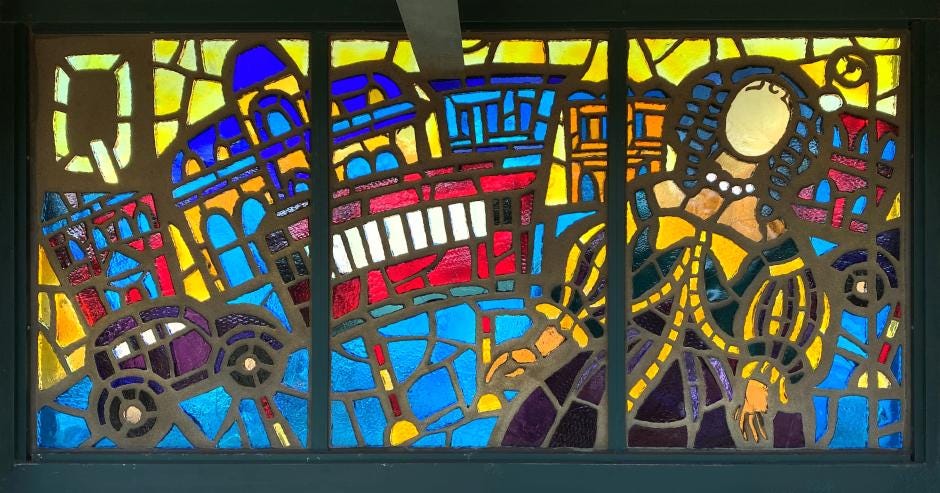
And here’s the MTA’s guide to the images at all three stations. I found them charming. Pro tip: exit the train to see them best. The windows of the #7 train are barely clean enough to allow daylight in.
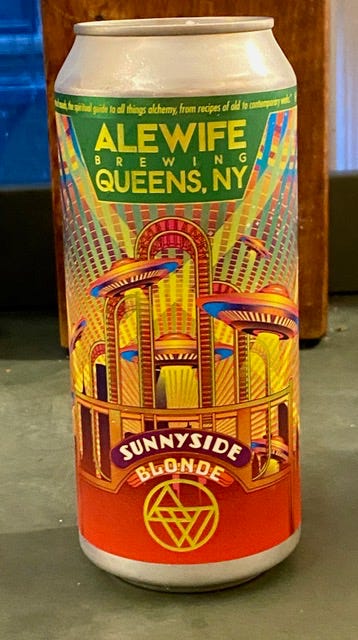
A giant Art Deco-style archway at 46th Street greets visitors at the base of the station, proudly introducing itself by name: SUNNYSIDE. A community group erected the arch in 1983 to revitalize the commercial corridor, refurbishing it in 2009. The archway has become an iconic symbol of the neighborhood. A local brewery called Alewife even features an ale called Sunnyside Blonde, whose label depicts the archway.
The archway has always had fans and detractors – even now. Me, I like a town with pride of place. (I am also a fan of the brewery.)
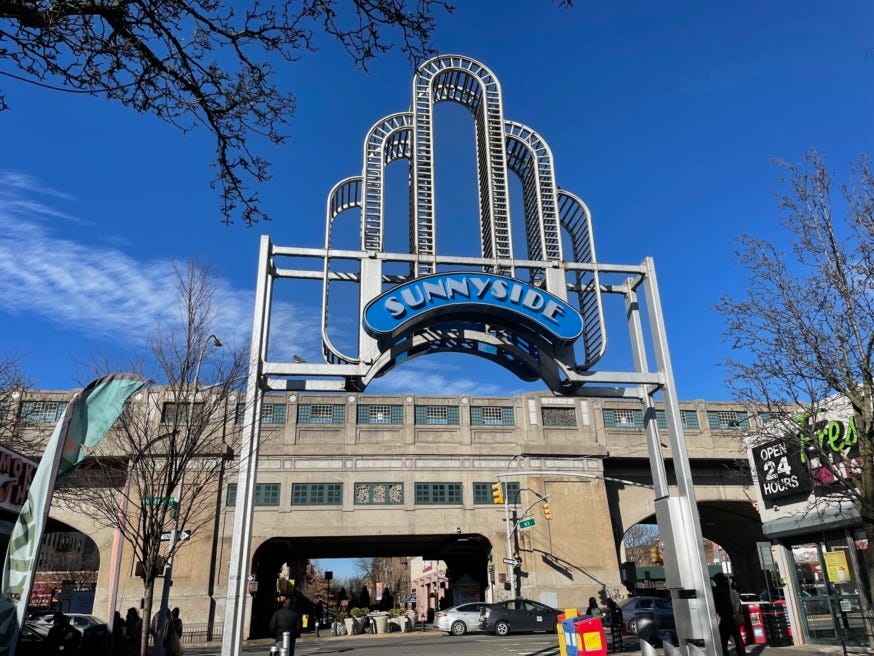
The small plaza at the arch hosts markets and small festivals. It’s also home to an annual concert honoring jazz legend and multi-instrumentalist Bix Beiderbecke, a native Iowan who spent his final days in Sunnyside. Beiderbecke died in 1931 at the age of 28, but the concerts began 80 years later, in 2001. Better late than never for fans who want their fix of Bix.
Happy Gathering
Lunch was the first order of the day because, well, that’s how I roll. (“Happy belly, happy baby,” my father used to say - in Yiddish.)
But how to choose? In just a few blocks I saw Korean, Indian, Chinese, Japanese, Romanian, Mexican, Filipino and Greek restaurants, and a pair of Irish pubs.
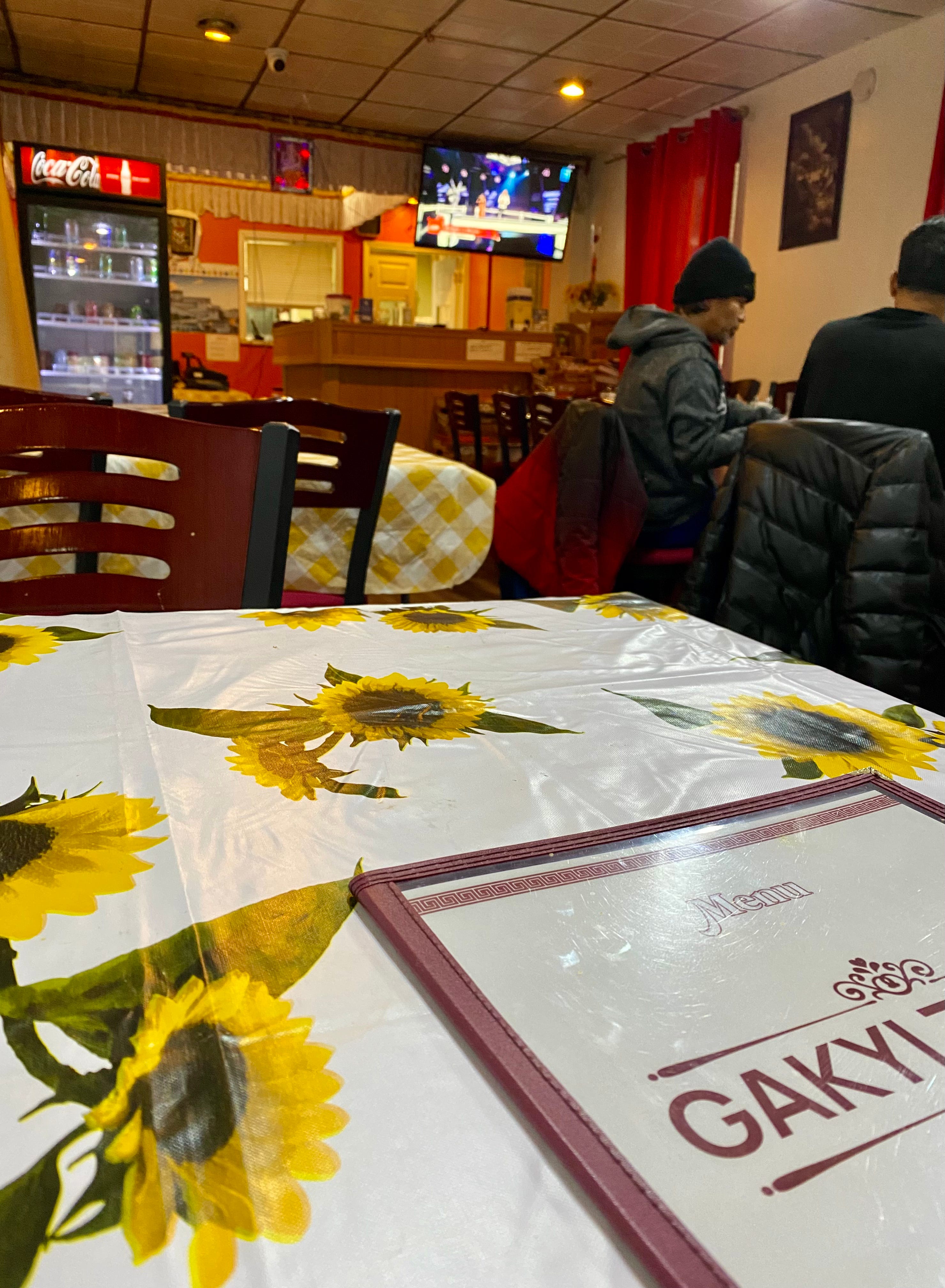
I continued along 47th Avenue until I noticed a small door across the street with a poster of food photos. I crossed over to see that the images were of Himalayan food, but the place looked dark. I pushed on the door - hard - and it opened. Inside I found the interior of Gakyi Zompe (“Happy Gathering”) at 47-11 47th Avenue, a lively, warm Himalayan restaurant, with tables topped by floral tablecloths, paintings of Tibetan (or Nepali?) people and yaks in traditional dress, and a few groups of men sitting around steaming bowls of soup.
A woman with limited English seated me and handed me a menu. The menu wasted no ink on descriptions, but the options were clear enough:
Chicken soup
Goat soup
Vegetable soup
Vegetable chowmein
Chicken chowmein
Beef chowmein
Pork chowmein
Beef momo
Chicken momo
Vegetable momo
Depending on your source, the menu is Tibetan, Nepalese or Bhutanese. Given the large numbers of Tibetan refugees in Nepal and Nepalese in Bhutan - and the close quarters of their new adopted home here in New York - the distinctions among the cuisines may be irrelevant.3
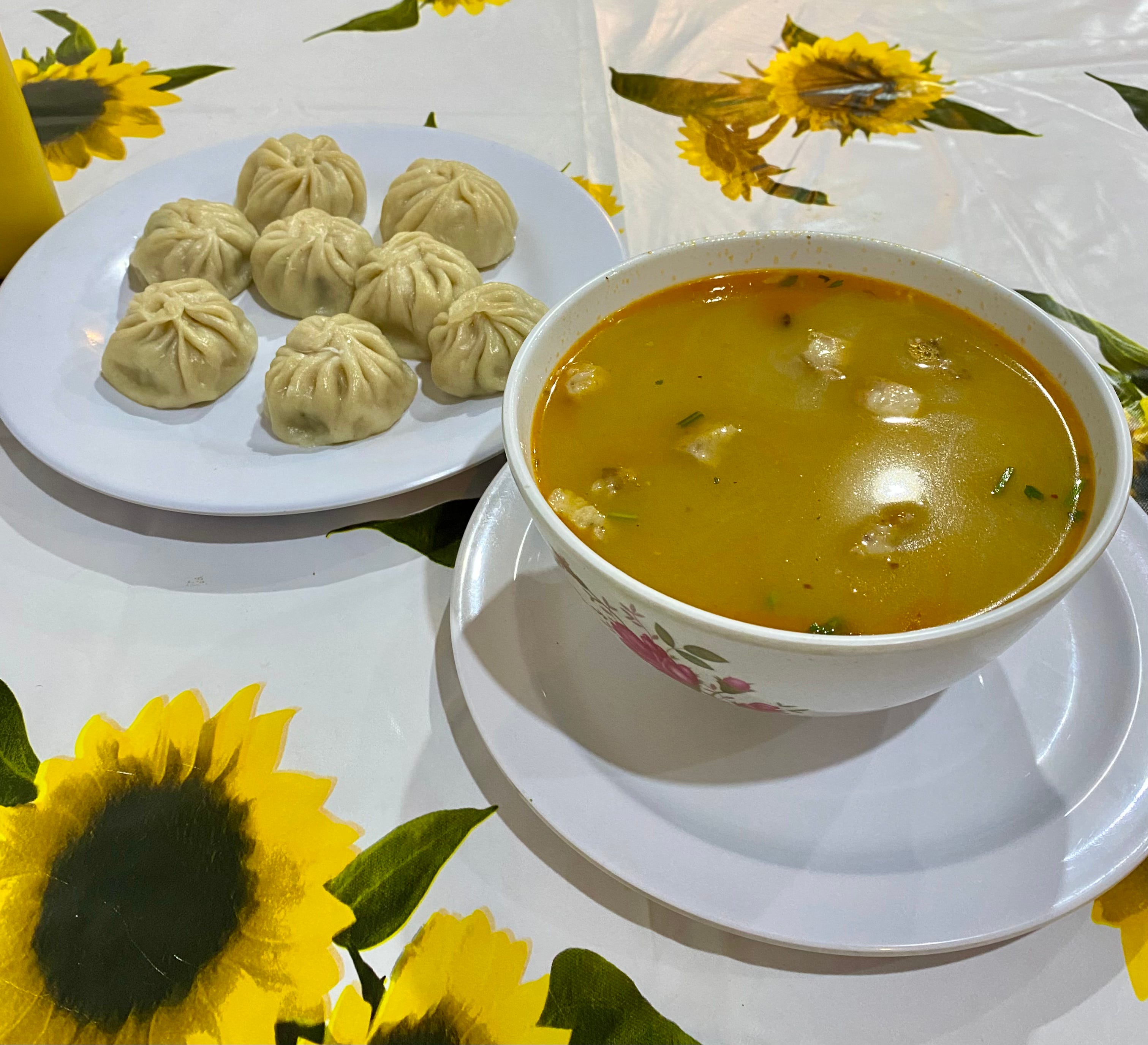
I ordered the chicken momo (dumplings) and goat soup. I asked the waitress to tell me how to say “goat soup” in Nepali. She told me – it included many syllables and some lovely whispery consonants – explaining that the first word meant “goat” and the second word, “soup.” As if we needed further evidence that we are more alike than different!
The momo were delicious – ground chicken with onion and herbs, perfectly-rolled dough. The goat soup was not exactly what I’d expected. Which was what? Something a little heftier than the thin, though flavorful, broth I got, I guess. But I will not tell a Himalayan chef how to prepare goat soup.
The highlight of the meal for me was The Voice of Nepal show playing on the TV mounted in the corner. I was mesmerized. The show is based on the international sensation show The Voice. Competitors perform pop songs before, or actually, behind, a panel of judges who are themselves either pop stars, former pop stars or Simon Cowell facsimiles – the tough-love industry insider whose approval is all the more gratifying when he showers praise on trembling competitors. (I think every country’s version of the Voice has a Cowell-like judge.) Success on the show emerges when the judges like the sound enough to turn their chairs around to face the musicians. The show has launched many a career.
Unfortunately for a music program, I couldn’t hear well – the volume was low (it was a restaurant, after all), the TV was about ten feet from my table, and other customers were doing what they should have been doing in a restaurant, i.e., clanging their spoons against their bowls, slurping and chatting. So I don’t actually know if the dialog was in English or Nepali or some combination.
But I could hear the amplified music. The sound was Nepali pop music. Not Indian film music and not western bubble gum, but unmistakably South Asian pop. I loved it. Even when the songs featured traditional instrumentation, the vibe was totally pop, as were the very 21st century wardrobes worn by the hip contestants and judges.
I was intrigued to learn that the winner of Season 4 (2022) of The Voice of Nepal was actually an American! Karan Rai, an immigrant to the U.S. from Nepal, was born in a refugee camp in eastern Nepal that housed Bhutanese people of Nepali descent who had fled Bhutan in the 1980s. His family had gone to Bhutan for work opportunities. A series of repressive actions by the Bhutanese government taken against its sizable population of ethnic Nepalis – some have called it ethnic cleansing – caused many to flee or they were expelled back to Nepal. However, Nepal did not accept them either, leaving more than 100,000 people essentially stateless. They are known as the Lhotshampa, and they comprised about one-sixth of Nepal’s population.
Karan’s family was able to enter the U.S. as refugees, under a program that accepted 60,000 of the Nepali-Bhutanese-Nepali-stateless families. They were resettled in Louisville, Kentucky. (There is anecdotal evidence that others now live in Queens.)
When Karen learned (from Facebook!) that any Nepali speaker was eligible to compete on The Voice, he threw his hat in the ring. I was proud of my country for adopting Karan and his fellow Lhotshampa and proud of the Voice of Nepal for including him. And proud of Karan for winning! I guess! (I don’t really have an opinion on this, not having heard the competition.)
I was so entranced by the show, and by Karan’s story, which I read on my phone during the commercials, that I barely noticed one of the customers waving enthusiastically at me. A big old friendly wave, but other than smiles and gestures, we didn’t talk. I guess he assumed I was just another American screen addict.
I couldn’t stretch my goat soup out any longer, so I paid up and pulled out – before learning who’d won the competition.
Queens Red Brick
I wove up and down residential streets, noting the early 20th century attached red brick houses, with their lovely geometric flourishes at the cornices. I don’t know who the architects of these workaday rowhouses was, but I was, and always am, moved by their decision to include a bit of imaginative embellishment in what are otherwise utilitarian structures. Everyone deserves a bit of beauty.
The buildings I’ve photographed here are two or three stories high. Most of the local residential structures are not more than six stories high. As I explained a previous post, six stories was the limit of the buildings’ ability to bring water to the top floor without the need for an expensive water tower. Builders also assumed that tenants would not walk up to a higher floor.
I was also thinking about how quiet and comfortable and convenient a neighborhood Sunnyside was, with its less-than-20-minute commute to Times Square.


Meta Feta
My food FOMO leads me to peer into practically every restaurant and market. I’m not proud of this compulsion, but occasionally I’m grateful for it.
When I passed the Parrot Coffee Market Place on Queens Boulevard, I assumed from a cursory glance that it was a generic American market…until I noticed a wall of Balkan red pepper spread. I did an about-face, entered, and wandered through the small aisles of products from throughout the Balkans and Turkey.
I spent the next half-hour trying to identify the store’s nationality, repeatedly thinking I’d figured it out from the merchandise and the conversations I overheard between the market’s staff and its customers. Aha! I thought. That’s a Turkish newspaper – of course! Then I’d spy Cyrillic product lettering and realize it must be Serbian or Macedonian! And then I’d see a map suggesting it was Albanian…!
I paused in the store’s bulk products aisle, which was evocative of so many Mediterranean markets. If I closed my eyes, I could distinguish the elements of the heady aroma of olives, coffee and za’atar. (Have I missed any?)
Balkan ajvar, a red pepper spread, is similar to the Romanian vegetable spread known as zacuscǎ, made with roasted peppers, eggplant and onions. Parrot, of course, carries both. And they are eye-catchingly red, a signal to passersby that they should do an about-face, enter and wander.
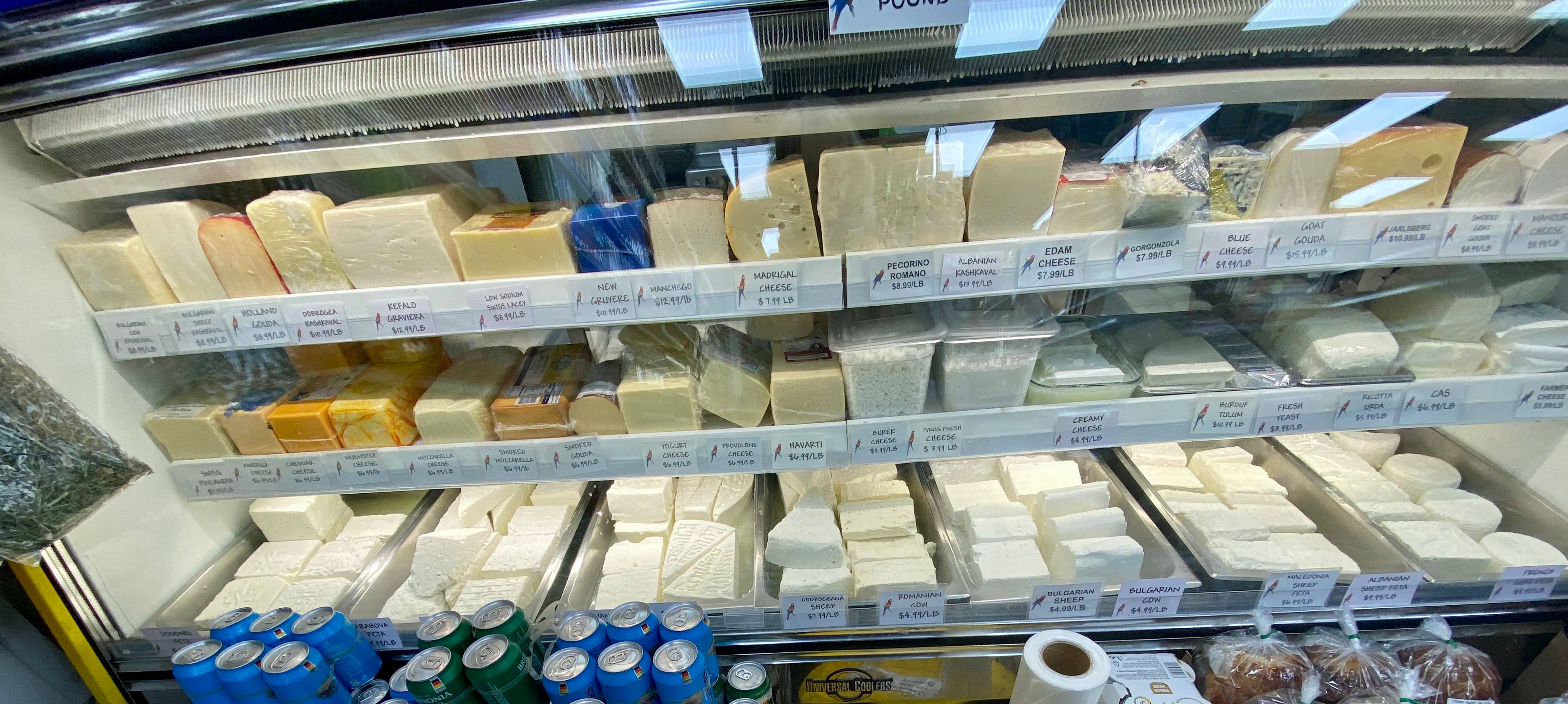
I made a pilgrimage to the feta cheese display case, marveling at the selection, the largest I’ve ever seen in the U.S. Some say feta is the oldest cheese in the world. From my perspective, there’s a reason for this. It’s food from the gods.
Parrot’s selection included:
Bulgarian (cow, goat, sheep), Greek (goat, sheep), Romanian (sheep), Macedonian (sheep), Albanian (sheep), French (goat, sheep), and more whose origins I didn’t note.
But wait! It turns out that many of these products may be in violation of E.U. law! In 2005, the European Union’s highest court ruled that feta is officially a Greek product – and not just Greek, but it must specifically come from one of seven regions in Greece. Just as tequila must come from the Jaliscan highlands of Mexico and champagne must come from, well, Champagne, feta is only feta if it’s produced in these areas.
The U.S., however does not recognize Greece’s ownership of the term. We Yanks consider “feta” a generic term. (Shhhh! Don’t tell the neighbors in nearby Astoria.)
The saleswoman at Parrot patiently offered me samples of several types of feta before I settled on the French sheep (what can I say, when it comes to food, there’s little the French don’t do better, whatever they call it).
When I paid for my cheese, I asked the woman what nationality the store considered itself. She just smiled and said “All Balkan.” Good enough for me. Parrot Coffee Market Place is located at 45-15 Queens Boulevard for All Your Balkan Plus Turkish needs.
But here’s a puzzle. Two blocks from Parrott Coffee Market Place is Parrott Coffee Market Place 2! I was as delighted as I was befuddled. PCMP2 is larger than its sister market to the west, with as many kinds of feta but also a full selection of meat and produce. I asked the clerk why they didn’t combine them. She suggested, sotto voce, that she’d heard the owners were planning to close one.
I learned later that the shop has several other locations in Queens and accepts online orders at parrotcoffee.com.
Sunny-side
It was getting cold and dark, but I was determined to see Sunnyside Gardens, an iconic planned community built 100 years ago. As I made my way there, architectural and commercial details lured me across the street more than once. The spectacular art deco doorway of Golden Gate Apartments, at 41-00 43rd Avenue, made me gasp. So too did a fascinating one-story Walgreens in a deco building sporting an un-lettered coat of arms - built for a Fraternal Order of the Somethings, I suppose. (The pharmacy employees gave me blank looks when I asked if they knew its origin.)


It was chilly! I could have used a coat of arms. Wait, isn’t that what we call a hug?
I turned north on 43rd Street just as the late afternoon light hit the east side, casting a heart-stopping glow on the block. Now I understood the neighborhood’s name! (Just kidding – the name comes from the French Hugenot family that bought the land in 1713 and named it Sunnyside Hill.) I crossed the street so I could photograph the sunny-side images, catching my breath at the impossibly electric hues. The newly bare trees and already red buildings positively shimmered.


Little Ado About A Big Something
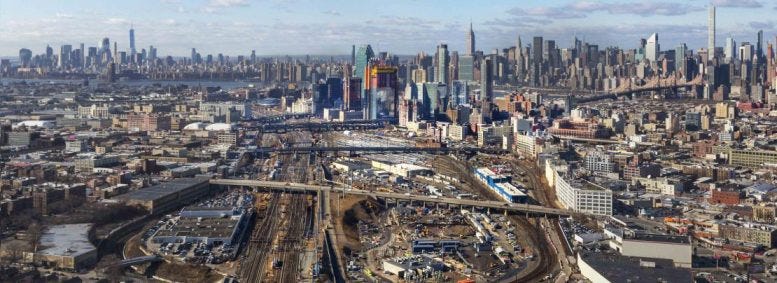
43rd Street ends at the Sunnyside Yard, which as of this writing is the site of a political debate about, of course, development. The proposed project comes out of a master plan developed by the City’s Economic Development Corporation and Amtrak in 2014. It includes a transportation hub that would accommodate all the region’s commuter rail lines plus Amtrak; green space; and 12,000 units of housing, including half for low-income tenants and half for middle-income. The plan evolved in response to public input and was revised and reissued in 2020.
Many locals are delighted – some have called it a once-in-a-generation opportunity. Others are distrustful, protesting that the social benefits (housing, parks, transit) are not sufficiently prescriptive and could expedite the gentrification already underway in the area, and that the #7 train won’t be able to absorb the new residents.
I’m on Team Art of Compromise: push the damn thing forward. 4
Sunnyside Yard: Interlocking Developments
Sunnyside Yard is home to the busiest railroad interchange in the U.S., a transportation landmark so important you’ve probably never heard of it. The Harold Interlocking, or “Harold,” as transit engineers call it, is the junction where the Long Island Railroad and Amtrak converge, and where signals prevent crashes and derailments every day. Seven hundred eighty-three trains pass through its controls each day.
The interchange is now controlled from Penn Station in Manhattan, so I couldn’t see any action, but that’s the point: its work is intended to be undetectable. It is a marvel.
The interlocking was built in 1908, but its first significant renovation didn’t take place until 1990, which I thought was a surprising interregnum considering the technological developments of the intervening years. More reconstruction began in 2009 as part of the LIRR’s recent billion-dollar addition of a stop at Grand Central. (Those renovations now need further work, to the frustration of railroad constituents, taxpayers and local pols.)
I wondered about the Harold’s unusual name. Turns out it was named for a nearby street called Harold Avenue, which was at some point renamed 39th Avenue. (No one seems to know who Harold was, however.) This name change represents a true loss of color, IMHO. It would be one thing if the renaming served to bring the street into conformance with a rational system of numbered streets in Queens. The borough’s repetitively and seemingly randomly numbered streets, roads, drives and avenues drive New Yorkers from other boroughs mad. (I’ll explain the crazy street numbering as I make my way through other Queens neighborhoods.)
But it wasn’t just Harold whose origin I questioned. I found it jarring to see “interlocking” used as a noun. Could it be? I checked a few railroad glossaries (yes, such exists, e.g., here and here). Shockingly interlockingless. Thank goodness for Wikipedia, which offers a history of the term. In 1856 a British engineer (pun intended) received the first patent for “interlocking switches and signals.” No one could argue that’s a mouthful. So they just noun-ified it.
Call it what you want. It saves lives.
Gardens/Apartments
Abutting the rail yards are the iconic residential developments known as Sunnyside Gardens and Phipps Garden Apartments, built between 1924 and 1928. They are often described as the nations’ first planned “garden community,” although other developments around the country - including the socialist Jewish housing complexes in the Bronx, built in the same decade - vie with them for that distinction.
When it opened, Sunnyside Gardens included 1,202 rowhouses and apartments across 55 acres within 17 city blocks, designed for middle-income renters and homeowners. They were inspired by the 19th-century English Garden City movement, which sought to integrate housing and landscape architecture to maximize urban and non-urban benefits. Deed restrictions guaranteed the properties’ long-term shared green spaces. In fact, their private backyards and the adjoining park are virtually the only parks in Sunnyside, and they belong exclusively to the residents of the developments.5 Like the surrounding housing, the buildings here are low-density homes, most six or fewer stories.


Social historian and New Yorker architecture critic Lewis Mumford was an original and probably the complex’s most renowned resident; nearby Skillman Avenue has been co-named Lewis Mumford Way in his honor. Musicians Rudy Valée, Judy Holliday and Perry Como are also alumni, along with actor James Caan.
As Close as it gets to “Park” in these Parts
In addition to the “courts” of green space and the backyards belonging to individual units, Sunnyside Gardens Park includes a spacious playground that was full of children and their caregivers on the cold sunny afternoon I visited. (The door was open, which I interpreted as an invitation, but officially it’s for Gardeners only.) The area felt like a secret garden, or a small town – as the planners intended. I couldn’t believe it was just blocks from the subway. It charmed me completely. I envied the sense of community as well as the individual and communal green spaces.
The covenants restricting backyards expired in 1964, permitting the sale of some of the common space to homeowners desiring more outdoor space. Since then, neighbors have debated, sometimes vehemently and even in court, how to balance homeowners’ rights and the preservation of the area’s unique character.
Unlike some housing developments, Sunnyside Gardens and Phipps never had covenants barring people of color. It was always a mixed-income development and sought to include low- and middle-income residents. That it has housed few Black residents is a reflection of the neighborhood’s demographics then and now - a dynamic that goes far beyond its borders. (Today its residents are about 28% Latino, 28% Asian, 41% White and 3% Black, like the rest of Sunnyside.)
Moving East is Moving Left?
During the Depression, Sunnyside Gardens homeowners and tenants - many left-leaning and inclined to collective action - waged a rent and mortgage strike; many had lost their jobs and couldn’t make their monthly payments. Their efforts were ultimately in vain, resulting in large-scale evictions and departures. But families, including many artists and writers, continued to arrive, mostly from Manhattan; at one point the influx of young families there earned the complex the moniker “the maternity ward of Greenwich Village.”
The early residents clearly and, may I say, unfairly, had it in for my own neighborhood, the Upper West Side of Manhattan. Their theme song, a spoof on a 1929 song and film Sunny Side Up, goes thus:
Come to Sunnyside now, now
Finest spot in the town
Some folks live on Riverside Drive
Their rents would keep armies alive
There are mansions on West End
But if you’d get the best end
Throw your cares away
Really there’s a way
Come to Sunnyside now.6
Adjacent Phipps Garden Apartments (472 units, constructed in 1931) also locates residential buildings around thoughtfully-planned courtyards. Phipps and Sunnyside Gardens shared a Cornell-trained landscape architect named Marjorie Sewell Cautley. Together they form the Sunnyside Gardens Historic District, placed on the National Register of Historic Places in 1984 and landmarked by the City in 2007.
*****
By now it had grown quite late and quite cold, and I knew it was time to head home. I strolled along Skillman Avenue, resisting the temptations of a Colombian bakery and a Turkish market before boarding the train where I’d begun my day. I knew I’d be back.
Day 2: November 30
But I didn’t anticipate how soon I’d return! A few days later I had a “why not today?” moment and hopped on the train to see the areas south of Queens Boulevard. Here, real estate prices are reportedly lower despite what appeared to me to be comparably desirable residential streets.
This time I was struck by the amount of new development on the Boulevard: several sleek glass-and-steel high-rise apartment buildings are under construction, suggesting higher-end rentals or condos. Gentrification discussions are lively and fraught as young people and families priced out of Astoria and Long Island City, to say nothing of Manhattan, creep eastward.
Despite my plans to head south, I started my visit a block north of the boulevard so I could check out a new Venezuelan place called Joropo (45-12 43rd Avenue). Venezuelan immigrants have flooded New York City since the spring of 2022, with tens of thousands arriving here without the benefit of earlier waves of immigrants from their country. Most have settled a bit east of Sunnyside, among the city’s communities of other Latin Americans (Ecuadoreans, Colombians, Peruvians, Guatemalans, Mexicans and more). But Sunnyside is adjacent and the boundaries are, as always, fuzzy.
Cachapa and Ketchup
The tiny restaurant – on the same block as the Walgreens with the coat of arms - seats about 15 diners. It was decorated sparsely but with obvious care, with Venezuelan musical instruments and crafts mounted on one wall.
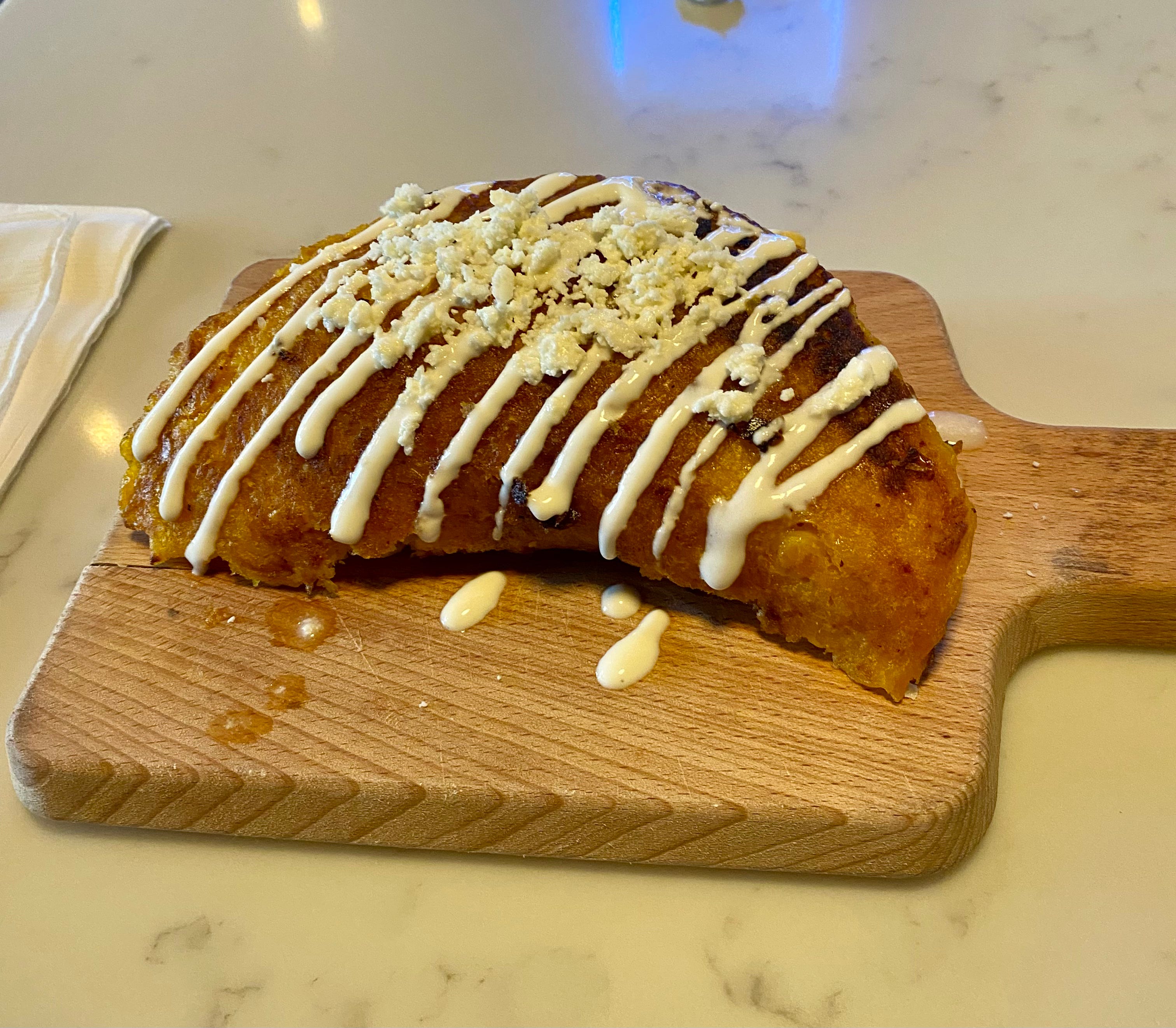
I asked the server (maybe she was the owner?) to explain the difference between arepas and cachapas, two kinds of corn cakes (think of a thick tortilla) popular in Venezuela and featured on the menu. She explained that arepas use white corn meal and tend to be thinner, while cachapas are made from sweet corn meal.
Cachapas were new to me, so I tried one, with homemade cheese and chicken. Joropo served it with a garlic mayo (salsa de ajo, which I learned later is a standard condiment in Venezuelan dining) and, at my request, a hot sauce. The mayo was a delicious supplement, but the hot sauce was not much more than ketchup with a tepid touch.
I enjoyed the meal, but the real problem was that the salsa wasn’t the only thing lacking heat: the place had none at all. The waitress, who disappeared behind the counter for most of my meal, was wearing an ankle-length fur coat against the day’s below-freezing temperatures. (From her outerwear, I surmised that she had not recently crossed the Darién Gap.) A space heater hanging from the wall was completely ineffectual, if it was even on.
The only way to close the front door - to keep the cold out - was to click it shut, which activated the lock. That meant that anytime a customer arrived they had to knock repeatedly and wait for the woman to unlock the door. But she was hiding out in her fur coat in the kitchen with the warm ovens, so the rest of us – a few young women who seemed to know her, and I – had to call out to her or open the door ourselves. I dined in my fleece vest and down jacket.
I will return in the warmer weather to enjoy Joropo’s attractive outdoor dining shed – with my own salsa picante. Joropo is at 45-12 43rd Avenue.7
Church…
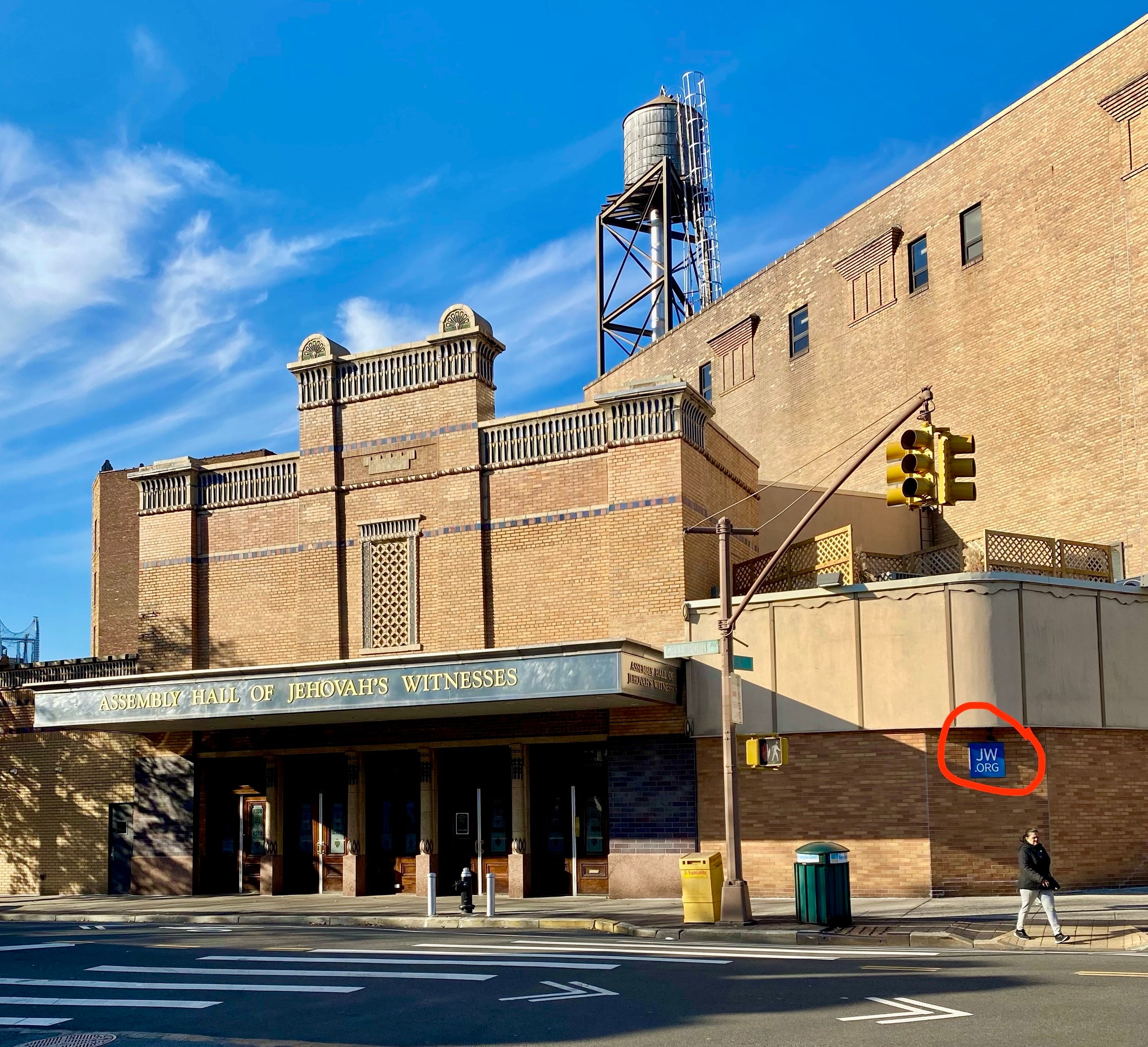
After lunch I headed south, as planned. At the corner of Greenpoint Avenue – a major commercial corridor in the neighborhood – I was struck by the number of houses of worship. First I passed the Assembly Hall of Jehovah’s Witnesses, notable for its Egyptian Revival-style tabernacle built in 1931 as the Bliss Theater. I thought it looked elegant but a little campy (like a theater!). The style was popular at the time (though not, I think, for churches).
And yes, this is the same Bliss as the guy for whom the 46th Street subway station is named – Neziah Bliss, the founder of Long Island City and also the primary developer of Greenpoint.
The Jehovah’s Witnesses church’s name is spelled out clearly on the edge of the marquee, while a small serviceable addition appears on the wall to the right, almost as an afterthought: “jw.org.” I mention the URL only because according to the church, that website is available in 300 languages. According to Ross Perlin, author of Language City,8 it’s actually available in more than a thousand languages, making it the most multi-lingual website on the internet.9
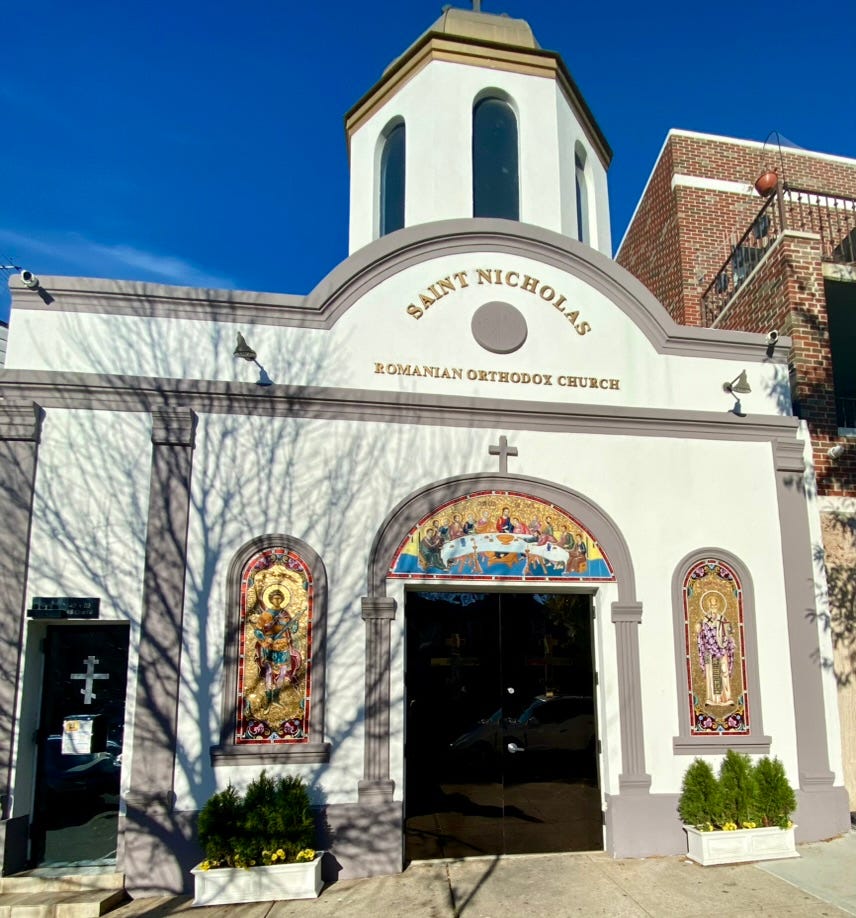
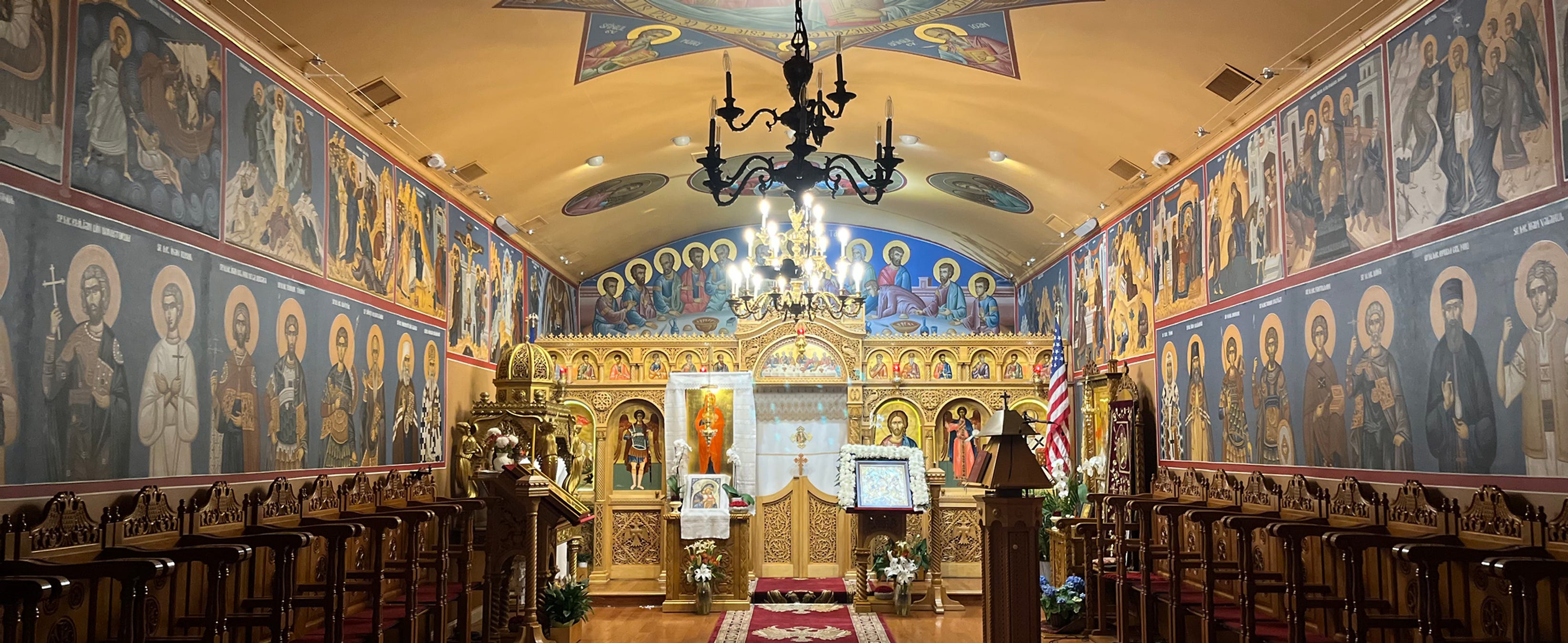
Around the corner from the church/theater, on 48th Avenue, are two more houses of worship, one across the street from the other, and a third that was recently sold and repurposed. The first is Saint Nicholas Romanian Orthodox Church, a beautiful structure built in the 1980s and ‘90s in the traditional Eastern Orthodox style, and further decorated and completed just last year, according to church records. I was only able to see its ornate gold and stained glass and Byzantine-style paintings on the street-facing façade. Online images from the interior – the church was locked when I visited, so I’m taking their word for it – are even more opulent.
Who are the members of the church’s congregation? Queens has New York City’s largest Romanian population (though not by much - Brooklyn is a close second). New York is actually the Romanianist city in the country. Ridgewood and Glendale (Queens) may have more Romanians (and Romanian churches) than Sunnyside, but Sunnyside’s is up there. Romanian restaurants, bakeries and professional services are located on Queens Boulevard and other nearby commercial stretches. And, of course, Parrott Coffee carries foods from the old country.
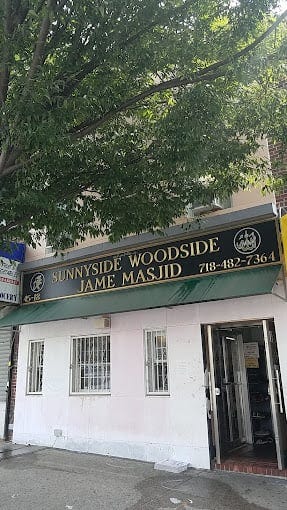
Until 2018, Saint Nicholas sat next to another church - the New York Korean Church of the Nazarene. (It’s an apartment building now.) And across the street is Sunnyside/Woodside Masjid (mosque), which I understand caters mostly to a Bengali-speaking (but Arabic-worshipping) congregation.
Sacred ground, Sunnyside.
…and Chow, South American style
This area of Queens is full of Latin American food: Colombian, Peruvian, Mexican, Ecuadorean, Guatemalan.
But not Paraguayan. Across the street from the constellation of churches, two dogs and two dog-walkers were standing at the door of a Paraguayan restaurant called I Love Paraguay (43-16 Greenpoint Avenue). The only one other Paraguayan restaurant in New York City (also in Queens) is an off-shoot of this one. As a stranger to the cuisine, I was curious. I saw from the menu that Paraguayan cooking is similar to Argentine food, with an abundance of empanadas and grilled meats. I’ll be back. 10
Continuing the South American theme, Bolivian Llama Party on the next block has a cult following. It got its start in the underground food hall at the Columbus Center subway station in Manhattan and also had a Rockaway Beach location. Both are now closed.
BLP describes its signature salteñas as “a cross between an empanada and a soup dumpling.” It didn’t appear to be open, but then it didn’t seem closed either: the lights were out, but music was blaring loudly from outdoor speakers (the excellent Peruvian salsa musicians Josimir y su Yambú). I waited at the take-out counter, but no employee showed up. This was actually very good fortune, because I probably wouldn’t have been able to resist a salteña and I was already stuffed like a cross between an empanada and a soup dumpling.
BLP may be the only Bolivian restaurant in New York. I had the salteñas in the Manhattan location and can vouch for them. But many years ago I travelled in Bolivia and can confirm that it is not one of the world’s great cuisines, salteñas notwithstanding. Please try them and tell me what you think! BLP is located at 44-14 48th Avenue.


Storytelling Settings
I ducked into the library next door. Adults of all ages - this was during school hours, after all - were reading, and two men were engaged in a silent game of high-concentration, hourglass-timed chess.
Several bays of books in Spanish, Korean and Chinese, as well as one marked “International Languages” - I noted, with curiosity, Turkish, Finnish and Romanian - lined one wall of the small space. Like all libraries in the system, the check-out system is digital, so it’s impossible to determine when some of these volumes were last taken to someone’s home (I tried!), and the library system does not publish the languages of checked-out books, only titles. So we can only imagine.


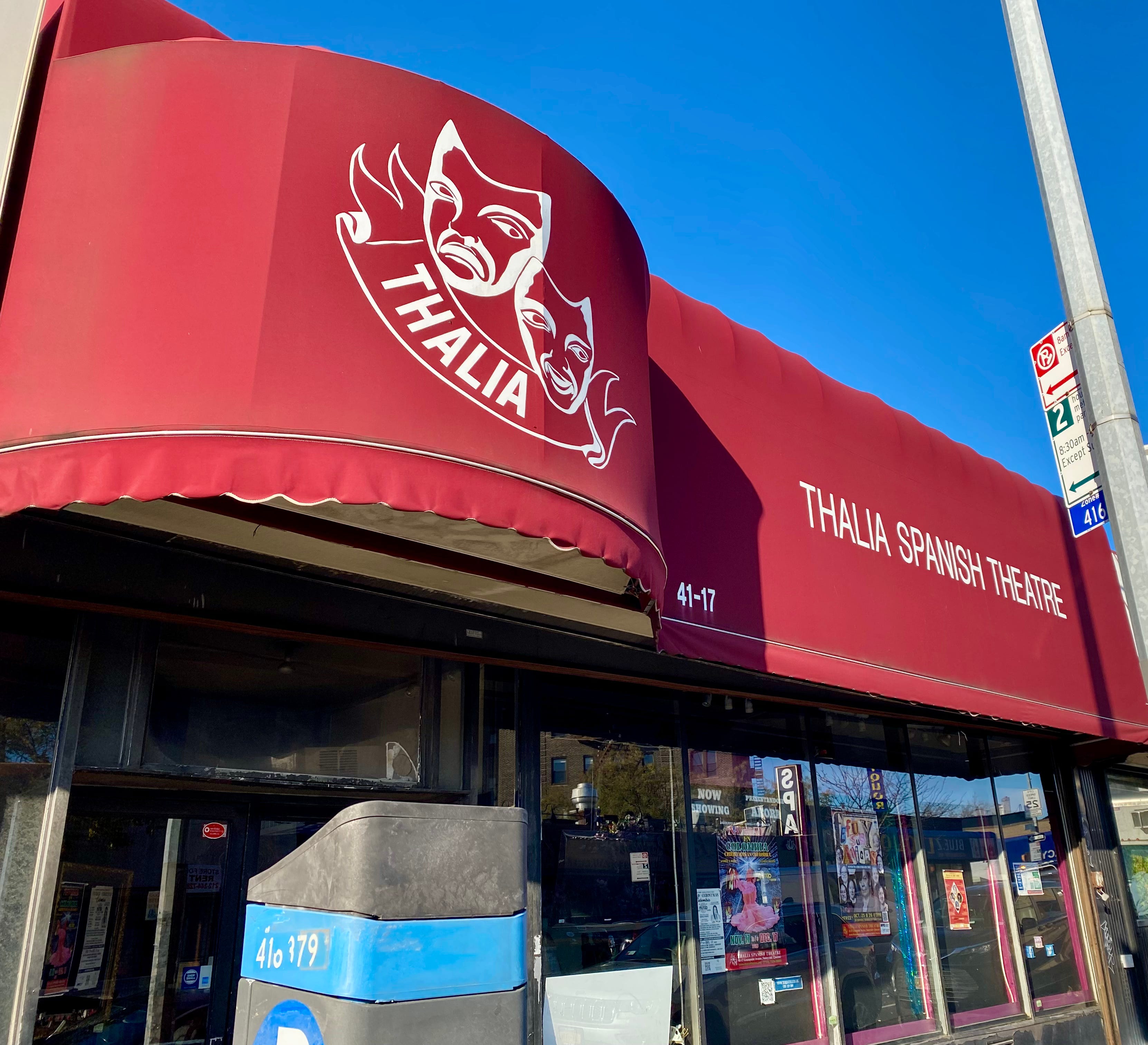
Down a block or two on Greenpoint Avenue is the Thalia Spanish Theater, for years the only Spanish-language theater in the city and “a cultural gem,” if it doesn’t say so itself (on its website).11
Since 1997, the theater has showcased drama, dance and music from Spain and Latin America. I’d heard about it for years and was surprised to see how modest the façade was – and how, well, let’s just say it could use a little holiday love. The theater was closed when I arrived, but was advertising its Christmas show, running for the next few weeks and featuring Colombian-American pop music.
Queens Screens
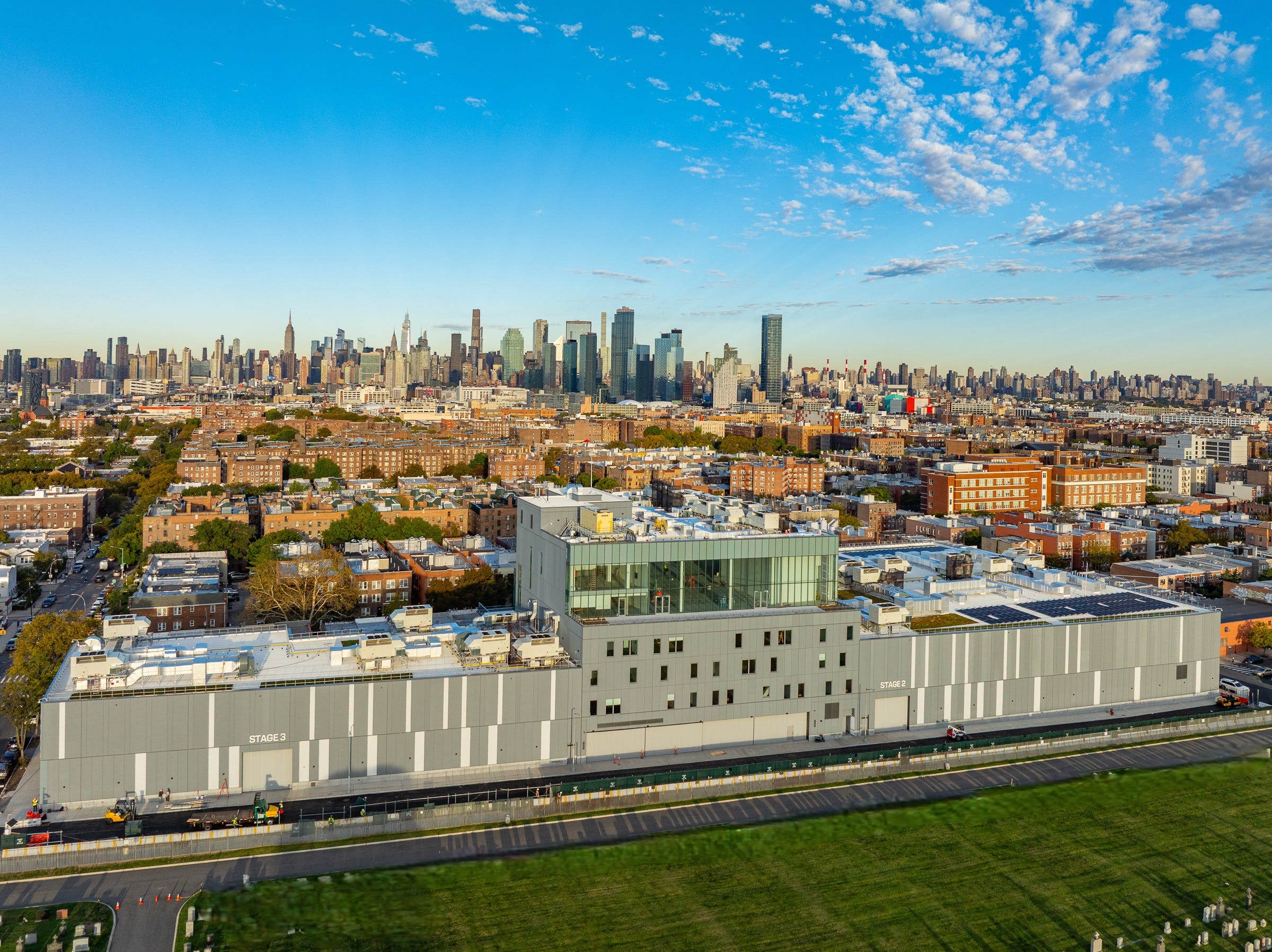
Sunnyside, adjacent Long Island City and Astoria have another important industry in the news today. On November 15 of this year, the city broke ground on the $275 million development of East End Studios’ Sunnyside movie production campus. East End, which will be located adjacent to Calvary Cemetery, joins Silvercup Studios on the Long Island City-Sunnyside border (with additional sites in LIC), Kaufman Astoria Studios and the in-progress Wildflower Studios further north, making western Queens a destination for film production.
This is not a new phenomenon. The area has been a moviemaking mecca for a century: Astoria Studios opened in 1920 as the New York location of Paramount Pictures, and has remained open almost continuously since then in some capacity. In recent years, Netflix, Apple TV, HBO and even Jim Henson’s Sesame Street have all produced series there.
Wandering Through and Beyond
I spent the rest of the afternoon strolling among Sunnyside’s residential streets, full of Unmistakable Queens Red Brick. This part of the neighborhood, which abuts Long Island City, also has lots of industrial blocks, and I peered into the windows of manufacturing facilities when I could.
From the bridge that connects Sunnyside and “downtown” Long Island City, the latter looks like its own little Big City, with its gleaming high-rise residences and office buildings. From a distance, LIC’s skyscrapers are indistinguishable from those in the backdrop of midtown Manhattan. How much longer till Sunnyside gets its own?


I’ll Be Back!
I grew extremely fond of Sunnyside during my walks. I know that gentrification has arrived, and that LIC’s glass-and-steel vibe is metastasizing eastward. Perhaps the railyards project will bring some surprises – some green space, some mixed housing. I’ll be watching.
Music for both days
Karan Rai on The Voice of Nepal, Season 4 – a slick, overproduced gem. I love every minute. Watch him engage with the judges. (He is well past the chair-swiveling phase here.)
Bix Beiderbecke, Rhythm King (1928), with brilliant early Mickey Mouse animation.
Joropo (also the name of the restaurant) is the 300-year-old national music and dance of Venezuela. Originating in the plains (el llano, so the music is referred to as música llanera), it has regional variants, but here’s a sweet piece that represents the genre as a whole, performed by one of its iconic interpreters, Ángel Custodio Loyola (1926-85). The music is popular in Colombia as well. Also heck out this short bit of joropo dance.
I can’t get enough of this stuff. Joropo is dope-o.
Josimir y su Yambú, La Protagonista (Peruvian, not Bolivian)
Here’s an adorable internet meme I wish I’d made: The Sunnyside Song
You didn’t think I’d leave you without this, did you?
Notes
Kenneth Jackson, ed., The Encyclopedia of New York City (Yale University Press, 1991 and 2010)
Note that the bridge was never spelled Queensborough; Queensboro was thought to be more American. In 2011 the bridge’s official name changed to the Ed Koch Queensboro Bridge, in honor of the three-term mayor. But everyone still calls it the 59th Street Bridge.
Queens is home to a significant population of immigrants from the Himalayan countries. The Nepali community in New York has grown rapidly. Between 2010 and 2020, it expanded fivefold, with close to 17,000 immigrants living here now. In addition, an estimated 15,000 Tibetan immigrants live in the New York/New Jersey area, and another thousand come from Bhutan. The heart of the community is in next-door Jackson Heights and Elmhurst. A Tibetan and Himalayan cultural and social services center operates in adjacent Elmhurst.
Update/non-update: as of early 2026, no development plans have been approved. But Mayor Zohran Mamdani has revived interest in the project. In February, he re-upped the proposal for 12,000 units of housing, formally making his request for federal investment in an in-person meeting with President Trump.
The dearth of public green space in Sunnyside is an abiding local issue. In September 2023, the City announced plans for a $12 million upgrade of several smaller spaces in the area. See https://sunnysidepost.com/council-member-won-announces-over-12m-in-funding-for-western-queens-parks.
Even in the early 20th century, the Upper West Side had a left-leaning political profile, which it certainly retains today. But yes, some of those buildings - new at the time - were pricey, and they continue to be so. My cynical take is that the Sunnysiders moved there from the UWS and missed Riverside and Central Parks. I know I would.
Only too bad for you that I took so long to post this - Joropo has closed! Fortunately, Venezuelan food has become increasingly available in New York. Here’s a crowd-sourced guide. And by the way, Joropo is in good company: the National Restaurant Association estimates that about 30% of restaurants don’t make it through their first year.
Ross Perlin, Language City: The Fight to Preserve Endangered Mother Tongues in New York. Atlantic Monthly Press, New York (2024)
Update: this location of the church closed in the summer of 2025. It was one of almost 170 in the New York City area, so you won’t have to travel far to find another one. Here’s a helpful map.
In 2015, the New York Times reviewed it, more description than opinion. Yelp reviewers are overwhelmingly positive.
A trustworthy Spanish journalist friend of mine who covers theater professionally reports that the Thalia’s offerings aren’t exactly adventurous. But there are multiple Spanish-language theaters in New York now, so hopefully there’s something for everyone.